Questions on the Future of Work

Mckinsey has released a long awaited (by me anyway) report on the future of work entitled A Future that Works: Automation, Employment, and Productivity. It is a very interesting look at the technologies which are affecting the future of human work. Every business and organisation should read it in full.

Mckinsey takes a distinctly different approach than the much discussed Frey and Osbourne Oxford report on the susceptibility of jobs to computerisation.

This difference can be best seen in the following graphic from the report:
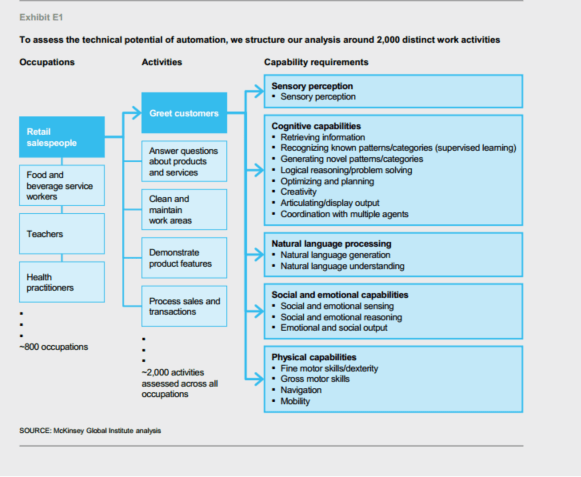
mckinsey-work-report-2017-exhibit-e1-18-separate-activities-mapped

Instead of looking at what jobs might be replaced the team at Mckinsey have examined all the activities that each job in the USA job market entails and then looked at the various capabilities for each of those activities. They have then mapped those activities against the possible timelines of those activities being able to be performed by technology.

This is important because except for very limited cases technology replaces activities rather than whole jobs.

From this approach Mckinsey have created various forecasts for both the types of activities and the sectors of the economy as shown in the next graphic which shows their view about the ability to automate those activities.
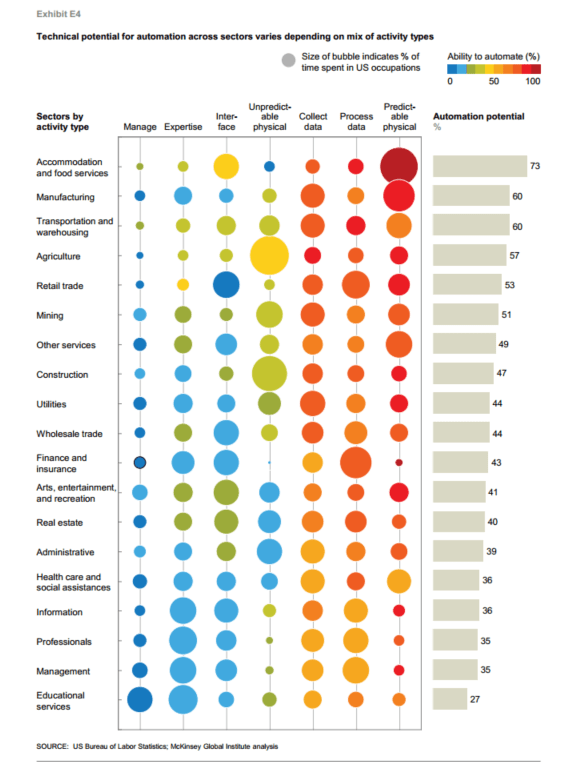
mckinsey-work-report-2017-exhibit-e4-different-sectors-mapped

Taken in aggregate their predictions are shown in the next graphic which I have annotated
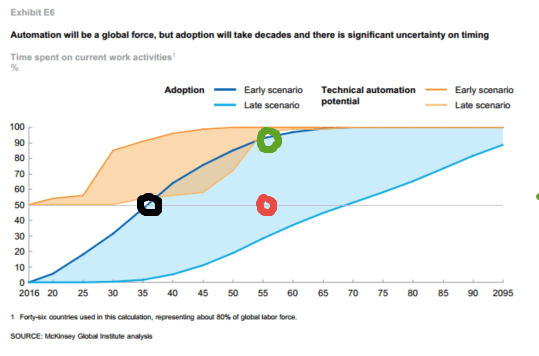
mckinsey-work-report-2017-exhibit-e6-adoption-scenarios-annotated

RED: Their median forecast that 50% of all current activities will be replaced by 2055

BLACK: The rapid adoption forecast that 50% of all activities will be replaced by 2035 (only 18 years away)

GREEN – The extrapolation of the rapid adoption forecast from 2035 that shows that over 90% of current activities will be replaced by 2055.

Mckinsey also states that:

 “According to our analysis, fewer than 5 percent of occupations can be entirely automated using current technology. However, about 60 percent of occupations could have 30 percent or more of their constituent activities automated”

Apart from praising Mckinsey (which I do not normally do) for creating such detailed and interesting work, and also in highlighting the inherent uncertainty in any forecast, this raises several interesting questions in terms of impacts and change.


From an organisational perspective those questions include::

  1. Setting aside the changes the technology makes to our business models and speed of doing business if 20-50% of activities are going to be replaced over the next 18 years how are we going to lead our people through the continual change that is going to be required? If the average is 50% then many people will have far more of their activities replaced.
  2. If technology takes over more and more of non-routine activities in our organisation what are the skills we are going to need?
  3. If technology pushes people out of the lower skilled activities in the whole economy how many people in the whole community are capable of carrying out the higher skilled activities we will need our people to concentrate on? Will we be in an even fiercer fight to recruit the people we need?

An article in the New York Times on January 30th 2017 describes When the German engineering company Siemens Energy opened a gas turbine production plant in Charlotte, North Carolina:

some 10,000 people showed up at a job fair for 800 positions. But fewer than 15 percent of the applicants were able to pass a reading, writing and math screening test geared toward a ninth-grade education

Eric Spiegel, who recently retired as president and chief executive of Siemens U.S.A. said “People on the plant floor need to be much more skilled than they were in the past. There are no jobs for high school graduates at Siemens today.”

From a societal point of view this raises questions of:

  1. Are we heading into a period of increasing structural unemployment?
  2. How will we design an education/learning system which gives your young people the skills they need to work in the changed economy and our post school/university people the capacity to re-skill?
  3. If education is changing to be more focused on re-skilling people for jobs how do we still supply the wider general benefits of education?

Part of the answer to the second question is contained in the New York Times article where it describes the companies getting heavily involved in educating and training people with guaranteed jobs at the end of the cycle, and just as importantly no student loan debt. This was mirrored in my conversation in a trip to Austin Texas last year. Austin is growing at an enormous rate and part of the reason is that some of the major tech companies have realised that if they do not get involved with students before they graduate they may never get to hire them. So they are moving major parts of their operations closer to the Universities with strong reputations in the skills they need. University of Texas Austin happens to be one of those. Students are becoming heavily involved and supported by the companies.

When I work with clients on these issues they should be focused on the effects on their business or their organisation but the conversation always turns to the wider implications for society.

The techno-optimist argument is that technology has been destroying human jobs for hundreds of years and we have always created new ones. That is partly because we have created new capabilities that need people, but also because we have reduced the costs of inputs to make otherwise uneconomic business models viable. Mckinsey argues in their report that their median forecast results in job losses that have already been experienced in society as we reduced the human employment levels in agriculture, and then again in manufacturing. This is true if the pace remains the same.

On top of that they argue that the productivity improvements are required because we are losing the huge contribution that population growth rates have contributed to economic growth over the last 100 years. That is a good argument.

It is a brave futurist who says this time is different and it is completely plausible that the combination of new jobs being created, and the demographic change we are experiencing, particularly in developed economies will mean that we will still have close to full employment. It is also plausible that:

  • The pace of change will be at the rate that fulfills the rapid adoption scenario that Mckinsey has envisaged, increasing the rate of job losses above previous experience.
  • That as technology pushes people out of a whole range of human capability jobs we will find that a significant minority of people do not have the ability to carry out the jobs that are created.
  • That a significant group of people that have the abilities will be left behind because they cannot gain the skills required to harness those abilities.
  • That the combination of the two groups will either have to work for very low wages in order to not be replaced by technology or be permanently unemployed.

That is a recipe for societal unrest way beyond what we have seen in the rise of Donald Trump and Marie Le Pen. If the political response to the issues of the people that have expressed their frustration at the current system is to promise a greater share of the benefits of the economy and a genuine attempt to do that is derailed because of technology changes we could be in for a very bumpy ride indeed.


Are The Two Major Supermarkets in Australia Doomed?

Yes but it will be a slow train crash

Following stories in the Australian Financial Review and News Limited last week (Amazon delays Australian launch to September to include fresh goods and Amazon to ‘destroy’ Aussie retail ) I decided to complete this analysis which has been kicking around in draft form on my system for a few weeks.

It is not just Amazon that is the problem. A combination of threats on margin, volume, and customer traffic is threatening the existing business model of the major supermarkets. Not all have to be successful for there to be major effects. To understand how that is happening we need to understand the business model.

A long time ago I tried to get ex Woolworths Chief Executive Paul Simons to come on board to market Australian Pork by becoming Chairman of the Australian Pork Corporation. That bid failed but something he told me about the supermarket business when we met has always stuck in my mind. Paul told me that there were five things that attracted people into supermarkets and while they were there they bought a heap of other stuff. Those five things were discounted bacon, Coca Cola, Pal Dog Food, fresh meat and fresh vegetables. A quick look at the Woolworths weekly specials catalogue for Victoria for the week starting August 31st (when I first started putting together this article) shows discount bacon, a discounted leg of lamb and a discounted whole duck front and centre on the first page. That is followed by  a full page spread on fridge mate packs featuring Coca Cola and two full pages of double points on fresh fruit and veg.

woolworth special august 31 2016

Source: Woolworths


Given that was the early nineties we could probably add rotisserie chickens, specialty pet foods, Huggies, petrol vouchers, and reward points to the list. That does not change the point that there are major group of items that get us in the shop and we buy other stuff when we are there. We certainly might buy half price Edgell Red Kidney Beans when we are there over another brand or product because they are on special but it is not going to get us in the door.

Later I chaired a board where a senior executive of one of the major supermarkets was also a board member. He told me that the supermarkets did not make money out of selling things. Their main two sources of income were the cash difference between when customers paid and when suppliers got paid and selling prominent shelf space to suppliers. While the story is illustrative of the business model rather than a statement of fact it does help understand the model.

If we look at the cash from customers as a source of of revenue then inventory turnover is important. The faster the inventory turnover the more money the supermarkets get in before they have to pay their suppliers.There are various numbers available for supermarket inventory turnover rates. The Inland Revenue Department of New Zealand reports median turnover of 14 times with a range of 10-19 for large supermarkets and grocery stores). The ratio of sales to inventory in the Woolworths annual reports 2011-2015 vary from 12.46 to 14.81 although these are affected by their non supermarket sales. Because this is not an investment analysis I think that it is safe to assume that the inventory turnover for Woolworths and Coles supermarket business would be at the higher level of the IRD estimates. If we use 16 x turnover that is equal to turning over inventory every 22.8 days. If the average payment terms to suppliers is 90 days (personal experience) that means that on average the supermarkets have customer cash for 67 days before they have to pay suppliers. With daily sales of  Australian Food and Liquor of $115.4m that is a whole lot of cash in the bank. Of course lower interest rates will have damaged the revenue the supermarkets receive form having that cash on hand.

When we look at paying for products to be on shelves and supplier rebates it was reported in The economist last year that In Australia supplier rebates had boosted margins for the major supermarkets by 2.5% point to 5.7% over the past five years (Buying up the shelves)

The other part of the business model puzzle is that the supermarket business is generally a low margin business once all costs are taken into account, although margins in the Australian market have been higher than the rest of the developed world. The Woolworths five year financial summary  to 2015 shows that margins for the Australian Food, Liquor and Petrol operations have been between 6.63% and 7.20% before interest and tax. While this is generally a low margin for businesses it is 30-42% higher than the margins in the Woolworths New Zealand supermarkets in the same report.The margin before interest and tax for 2016 fell dramatically to 4.43% as Woolworths lowered prices to compete with Coles and Aldi. The margins before interest and tax for Coles supermarkets in 2016 and 2015 were 4.73% and 4.67% respectively ( http://www.wesfarmers.com.au/docs/default-source/Quick-guides/2016-full-year-results-shareholder-quick-guide.pdf?sfvrsn=2).

While this net margin is quite low the gross margin is much higher For example the gross margin for Woolworths was 25.37% and 26.19% for 2016 and 2015 respectively ( Woolworths Financial Reports (pdf )) .

The gross margin is essentially sales minus the costs of purchasing goods for sale. This means that the difference between gross margin and net margin is all the other costs such as property leases, energy, staff, etc. This is a critical point because it means that the contribution to profit of the last customer or the extra sale is much higher than the average across the business. What this means is that if I drive down the road and turn left to shop at Woolworths or turn right to shop at Coles the loss in sales to the one I do not choose is very high. Whether I turn right or left both those businesses still have to pay their staff, pay their energy bills, pay their property leases, etc. That means that if roughly 18% of customers disappear and they cannot adjust their costs then their profit disappears, and adjusting high fixed costs like leases, staff and energy is very difficult.

The same applies to sales volumes. If the same amount of customers go through the door but buy 18% less in volume the supermarkets do not make 20% less profit, they make virtually nothing if the same costs structure remains in place.

So the supermarkets run a high turnover, low margin, high fixed cost business where they make lots of money on inventory turnover and payments/rebates from suppliers. This gives is the basis to look at their strategic future. Attacks to their profitability can come from primarily three points:

  1. Lower margin business forcing them to reduce margins as Woolworths has done in 2016 to combat the threat of Coles and Aldi in particular. This may be extended further in a major Amazon push into fresh produce.
  2. Customers being drained away so the high costs structure causes problems for profitability.
  3. Customer numbers staying the same but buying less every time they go to the supermarket.

Lets look at each of those individually:

Customer numbers staying the same but buying less every time they go to the supermarket.

This is the most serious threat to the long term viability of the supermarket businesses. The threat is analogous to guerrilla warfare or asymmetric warfare. Only some of the attacks need to be successful for the supermarkets to be in trouble. People will still go to the supermarket but there purchases will be reduced.There have been lots of efforts to look at direct delivery models with varying success but we are now reaching the point where multiple models are developing that have a good chance of being successful. This is devastating for the supermarkets because if 40% of people reduce their purchases by 30% that is a 12% reduction in  overall sales. But the supermarkets will still have to operate their existing business model to retain the other 60%of customers  as well as to be able to retain the people that have reduced their purchases but are still coming into the store. Lets look at some of their threats:

Dollar Shaver Club

dollar-shaver-club

These guys run a direct delivery service for razors direct to your door. They combine an irreverent marketing attitude with social marketing that gives you free blades if you recommend a friend.  They promise to reduce your costs of shaving and take all the friction out of the process. I don’t use a razor any more as I use clippers to manage my George Clooney like designer stubble, but if I did use razor I would sign up today – no longer buying that product from the supermarket. A small individual purchase perhaps but they start to add up.

Blue Apron

blue-apron

Blue Apron promotes direct delivery of all the ingredients you need to prepare a healthy great tasting meal. I met with one of the Nokia trends scouts in Austin Texas a few weeks ago and she is an avid fan. As Blue Apron delivers the exact amount she needs to make a meal there is no waste and she said that the service is not costing her any more money than shopping for the ingredients. It is estimated that Australians throw away about $8 billion dollars of food a year (fact checked by the ABC) so certainly there is a cost saving there. While they are not yet in Australia the business model is one that is easily transferable here.

Youfoodz

youfoodz

Youfoodz is a company that will deliver a week’s worth of fresh (non frozen) meals direct to your door in Australia. You can choose all meals or a proportion of meals and snacks. I have done a cost comparison on their service and while they are slightly more expensive than making your own food for quality meals the difference is not large. Again there is no waste and for the time poor there is no shopping or preparation to be done. For people working long hours or running their own businesses where more time means more money this is a very viable alternative.

Amazon Dash

amazon-dash-button-washing-machineAmazon Dash is a programmable button that you can put in your house. The example here is one of putting one on your washing machine so that when you run out of washing powder you just push the button and washing powder is delivered into your house. It takes all the friction out of buying and I imagine them building in services integrated with Alexa (the interactive home system) so that rather than just buying your normal brand the system can queue up order requests and talk to you about special offers, etc at your convenience. Once adoption gets high enough then Amazon can use its considerable logistics and information system to package up multiple orders, supply weekly orders based on your usage, and give you special offers.  It has not really caught on yet but the system is adding more and more brands and Amazon is pushing it out to more countries (Amazon triples Dash Button brand lineup, orders surge 75% in Q1  andAmazon brings its Dash buttons to the UK, Germany and Austria for ordering staples with one touch). It has the smell of a long term strategy to harness all of their capabilities into an offering that makes sense, especially for dry goods.

So if we think of an example household of an above average income couple (the most attractive customer) that are busy with work or their own business you can imagine a combination of all of these services. They use a service like Youfoodz to have a couple of meals pre-supplied on their two busiest days of the week when a combination of work and commitments for kids activities have them stretched. They use a service like Blue Apron once a fortnight for a lunch or a dinner where they want to cook but want to eat healthy and not think about recipes or shopping. They use Dollar Shave Club for monthly supplies of razors. They install Amazon Dash buttons for washing powder, toilet paper, paper towels, dish washing liquid, and cereal and it all gets delivered. Gradually Amazon influences them through their Alexa to buy more dry goods because the marginal cost of freight is so low the system is cheaper. Convenient and lower cost is a killer combination.

They still go to the supermarket they always went to but slowly but surely the amount they buy there until it is down to 50%. Some families at that level then start questioning the trip to the supermarket and start changing their total shopping habits.

The problem with all this from the major supermarkets point of view is that they don’t really have a strategic response that makes sense because of their legacy model. They cannot abandon the majority of their customers so their model stays the same and their margins get steadily eroded.

If they reduce stock lines then they slide more towards an Aldi/Costco model and they don’t want to go there. If they move to more and more online systems they can sort of compete but they still have to supply their standard customers and that model is based on big stores based in solid catchment areas. If they close one of them or move to a small store model a lot of customers probably end up with their competitor who did not close. So neither wants to be the first to do that. It is a little like the banking branch model problem. Less and less transaction are being carried out in branches but people will not travel far to conduct those less frequent transactions so banks keep branches open for fear of losing customers.

At every step of the way their business model is eroded:

  • Lower customer traffic/less spend per customer reduces cash held in the money market.
  • Lower customer traffic/less spend per customer erodes margins as there are less customers/customer dollars to spread non cost of goods costs over.
  • Lower customer traffic erodes the capacity they have to charge for shelf space. It is a bit like television advertising rates. If you have less eyeballs watching your shows you cannot charge as much for advertising.

The final straw in this nightmare scenario for the major supermarkets may be Amazon moving its vision to applying its impressive logistics and intelligence systems to support a national network of independent specialty shops. This is where the high margin customer of the future, who has already reduced their supermarket purchases as described above, may be headed. If that is the case then the major supermarkets are caught trapped in a legacy business model they cannot get out of and assailed on all sides.

Only 5% of each attack has to be successful. No-one has to destroy them.

Agriculture, Technology and Future Careers

Paul Presenting at Bendigo November 2015 Teachers Agriculture and Career Opportunities

A couple of weeks ago it was my privilege along with several other speakers to engage with a roomful of teachers to talk about future possible careers for their students in Agriculture based around technology. The overall message was that the future was very bright for those with the passion and sills in technology to have well paid and fulfilling careers in the regions.

You can access the presentation at :

Agriculture, Technology and Careers 

The key messages were:

  • That more and more value is going to be created through data and technology in agriculture. For example Merrill Lynch has released a report saying that the use of agricultural drones are projected to create 100,000 jobs and $82 billion in economic value over the next decade in America alone. This prediction n terms of where drones will be used is seen strikingly in the following graph:

drone predictions for agriculture in the USA

source: http://www.marketwatch.com/story/how-drones-will-drastically-transform-us-agriculture-in-one-chart-2015-11-17 

  • Because of this there is going to be a massive demand for people with the skills to create and supply services into agriculture.
  • That because many of these services can be supplied via the internet or via mobile phones there is both an opportunity and a risk. If we can build a capacity regionally then we can both defend ourselves against outside providers and provide services in other countries and regions.
  • That the skills will be a combination of technology, the capacity to collaborate, and the understanding of agricultural business models.
  • The skills are also transferrable. So for example if we want to maintain aged care services at the highest possible level in regional communities the capacity to use predictive data and healthcare data will be vital. Therefore developing the skills opens up far more career opportunities than just agriculture. On top of that our ability to maintain viable regional communities will be in part dependent on these skills and I would much rather have people in our communities supplying the services than money flowing out of the community to service providers elsewhere.
  • That we need three things. Passion, market and skills.  I think that it is obvious that there is a market but if you have a market and no skills you cannot provide the necessary services . And if you have skills and market but no passion you will burnout. Therefore we need to help equip those individuals with the passion to be involved with the skills to support that passion.

Following the day there was a significant increase in the number of teachers who saw possibilities for their students in agriculture.

I would like thank the Bendigo Tertiary Education Partnership  and Community Leadership Loddon Murray Inc,and especially Kerry Anderson for inviting me along.

I believe that there is huge potential in our regions for careers around technology and we need to grasp that opportunity now.

Bolted on and Squeezed In – Is New Car Technology Killing People?

I was watching TV on the weekend and the ad for the Holden Trax caught my eye.

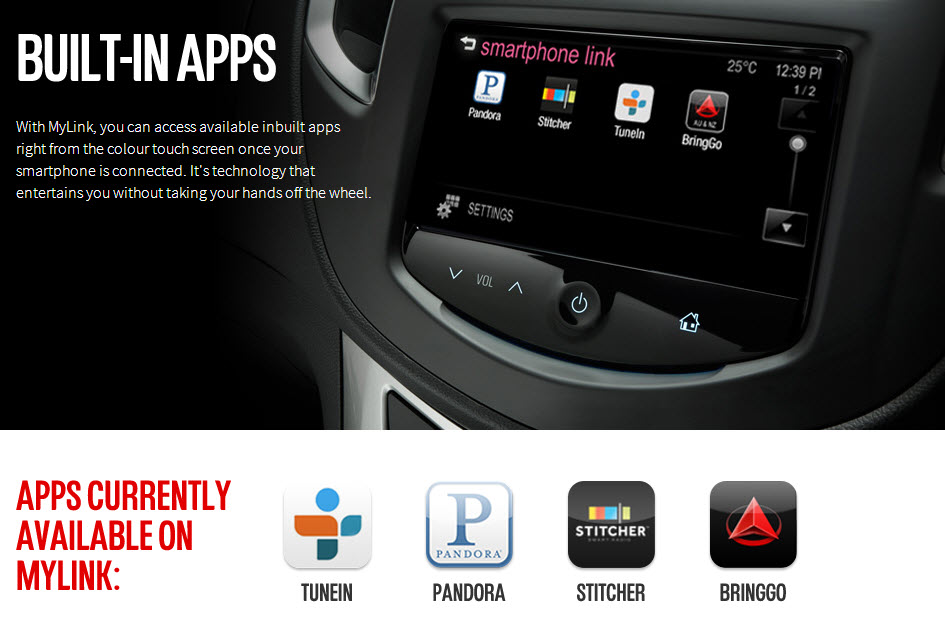
It is a small SUV (what the hell is that – sounds about as logical as a miniature sun hat) but what I really noticed was the spruiking  that they are doing for its advanced technology. On the Holden website this is described as:

“Pair a smartphone[01] with Holden MyLink and access your contact and recent call lists, music playlists or certain mobile apps right on the 7″ colour touch-screen while the phone is safely stored away”

and

” Speak to friends and family safely while driving. Enjoy your favourite music or news programs”

Lets look at those statement one by one.

Firstly the heavy emphasis on web/mobile/smartphone technology. This strikes me as partly hype because if you look at the small print you get:

Image

and :

“certain mobile apps right on the 7″ colour touch-screen while the phone is safely stored away”

This reminded me of a video that Venture Capitalist Fred Wilson posted to his site on the weekend:

Video Of The Week: Mobile To The Future

Where Luke Wroblewski presented a Google talk last year on the importance of the transition to mobile. In that video Luke talks about how when we transition from one technology of mass media to another we try and transport across most of the applications from the previous model. So lots of early TV programs were filmed radio programs. and lots of early mobile experience was/is the web translated to mobile. He gives some great examples and as Fred says the first 30 minutes are well worth watching.

This also reminds me of what is going on in social media in business these days. Most organisations are bolting on, and squeezing in applications and process into their current business and organisational model. The smart ones are using social media and social tools to reorganise their business and organisational models.

What is happening right now in smart technology in cars feels very much like that. Bolting on and adding capabilities in order to increase marketing hype to sell cars. While I am sure the car companies have plans to expand the range of applications and the flexibility of the systems involved it all feels and looks bolted on. I am all for new technology in cars. For example systems that allow car sharing, GPS location systems for a range of possibilities, and more importantly the technology for driverless cars.

But if companies muck up a transition to mobile as the new mass media, or struggle to come to terms with social business tools it is important but not vital. They can lose profit , or market share, or at the worst go out of business.

Which brings me to the statement on safety. If we get technology implementation wrong in cars then people get hurt and killed. While there is some varying reports and research on the matter it appears that on the balance of probabilities that the hands free use of mobile phones increases crash risk:

The Fact Sheet from Curtin-Monash Accident : Using Mobile Telephones While Driving makes the following conclusion:

“As noted by the US National Road Safety Council13, the increasing recognition of mobile
telephone use while driving has resulted in numerous pieces of legislation aimed at
improving driver safety. At the same time, the Council also noted that nearly all
legislation focuses on banning only hand-held telephones or only texting while driving. It
seems that the same situation holds true in Australia generally and Western Australia
specifically.

The body of evidence strongly indicates that the use of both hand-held and hands-free
mobile phones while driving is dangerous. Legislation which aims to curb any use of
mobile telephones while driving is to therefore be welcomed in principle. However
legislation which leaves the driver free to use hands-free telephones for conversation and
other purposes is ignoring a vast body of research findings and remains inadequate from a safety perspective”

and recently the Victorian Coroner has recommended banning on mobile phone use in cars:

Coroner pushes to ban all phones while driving: hand-frees phones ‘just as dangerous’

It seems highly likely that the integration of applications and touch interfaces will increase this risk. While it is legal in Australia to drive with a hands free mobile system that is in a fitted car system it would seem to me that the “ Speak to friends and family safely while driving” statement is misleading advertising at best.

The use of foresight in technology adoption is both about creating new ways of doing things but also to look for unintended consequences and new risks. I don’t think much foresight is being used in the technology adoption race in cars. The sooner we have driverless cars and we can all use our smartphones. tablets and wearable technology at will the better.

The question has to be is the advance in value worth the risks? In this case I would have to say no.

Paul Higgins


Addendum Link:

Cars are the new smartphones: Chevrolet adding LTE and app store to 2015 models