Brexit Vote a Fantastic Opportunity

There is a lot being spoken about the vote for the UK to leave the EU but I think it is time for everyone to slow down a bit and take the time to digest what has happened and think about the opportunity. Once when I was young and involved in national agri-politics here in Australia I tried to get four national bodies amalgamated into one (of course orders of magnitude less complex than the UK/EU situation). I lost that vote 17-16 on the conference floor. A wise old hand came up to me later and said “son, that is the best loss you will ever have”. What he meant was that a close yes vote would have emboldened the opponents to undermine any moves to make the vote into reality and caused more problems than it was worth.

The effort was subsequently re-attempted (not by me but with my support) and passed unanimously. I was asked to come back and chair the new body which  has operated successfully ever since. Now the situation in the UK is much more complex but the principles are the same. The vote has a majority and that is how democracy works. However the margin is not large, and while governments have to be elected by a simple majority, making seismic decisions of the type that we are discussing here needs much more support by the people. From a distance the referendum seems to have riven the country more than just a simple 52-48 vote. The leave vote has a clear majority and is entitled to take that in the way that the referendum was intended. However there is a very large minority that disagreed. Within that difference there are significant fault lines:

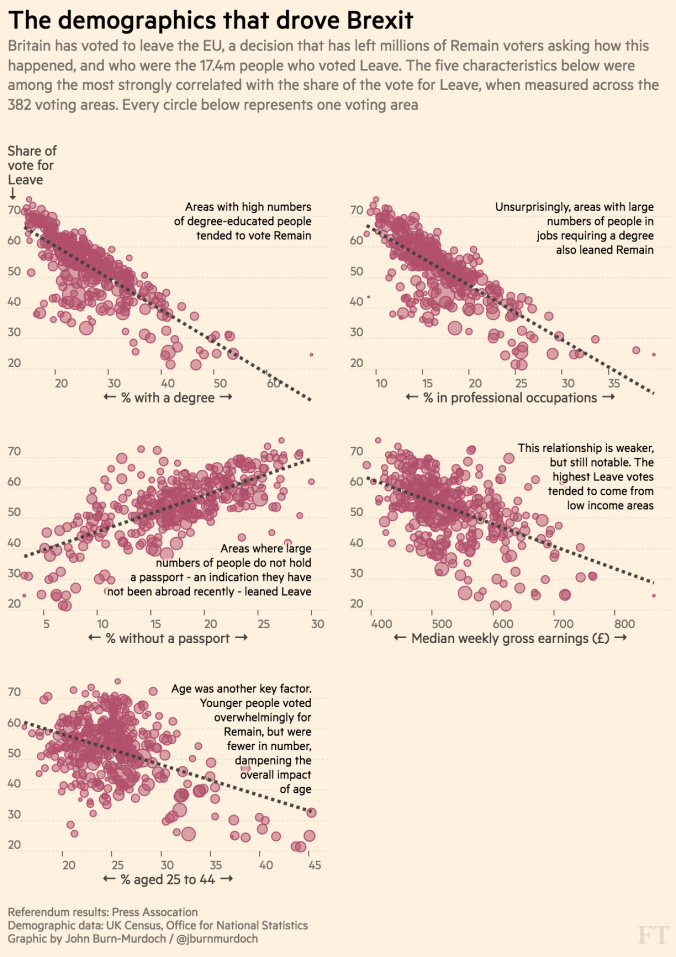
  • The older people seem to have voted largely to leave while a large majority of those under 24 and under voted to stay.
  • The Scots voted overwhelmingly to stay.
  • Areas with people with a larger percentage of tertiary degrees voted to stay.
 

brexit-big-five financial times demographics

Source: http://blogs.ft.com/ftdata/2016/06/24/brexit-demographic-divide-eu-referendum-results/

There are other differences as well.

Again from a distance,  the leave vote seems to be the combination of a number of sub groups with different concerns including the lack of real democracy in the EU, the effects of globalisation on their communities, the feeling that the political elites have ignored their concerns, issues with immigration, etc. I cannot possibly analyse these in any detail from a distance but I think the real opportunity is to really understand what has happened here and change political party attitudes and policies both in the EU and the UK. What has happened in the UK seems to be a microcosm of significant political disillusionment playing out across the world so we need to take the time to slow down and utilise the opportunity. This will take real leadership at every level and across the political divide, perhaps too much to expect?

In practical terms I think that this means:

Delaying any decision formally enact article 50 to start the negotiations to leave the EU. This is an enormously difficult and long process so the delay of a few months will not affect it adversely. This will give everyone a chance to sit back and think more deeply about what has happened and have calm negotiations.

Then the course can be:

1/ Enact article 50 and go through the process.

OR

2/ Revisit the referendum for a second vote.

Of course re-visiting the vote is fraught with problems. The leave vote can claim they have a clear mandate and it would be a disaster to run a second referendum and have the stay vote win 52-48. That would leave the country riven with deeper entrenched fault lines. Therefore it could only be done if:

1/ There is a genuine attempt by the major political parties to understand the political problems that have created the divide and address them via both domestic and European policy and legislation. This would have to include negotiation with the EU which they may or not wish to do (see EU leaders call for UK to leave as soon as possible ). Another reason for everyone to take a step back and think through things. It may be that negotiations with the UK could be helpful in precluding other problems within the EU.

2/ After that,and only after that there is a clear indication via respected and independent polling that a significant majority (say 60% or better) that they want a second referendum.

For this to be successful the subsequent vote would have to have a much clearer majority.

Personally I favour looking to see if the second referendum can work but the main thrust of what I am saying is that a calm and detailed analysis of what has happened should be the prelude to what happens next. Otherwise the UK risks being affected by the significant fault lines that underlie the votes of various groups. That could cause significantly more problems than staying in or leaving the EU.

As the cliche goes we should never miss the opportunity of a crisis.


Paul Higgins


Note: Before people start commenting about someone from the other side of the world commenting on this I was born in the North of the UK (Oldham, just near Manchester) and still hold dual passports. I still have lots of family there and have visited several time and just this month had family here from the UK discussing the referendum at length. I also have some experience in politics having been President of Country Labor in Victoria here and running for Federal pre-selection twice in regional seats. So I have some experience in the difference between city and regional people and their politics, albeit in a different country. Having said that it should be the thinking that is critiqued.


A Painless Way To Tax?

The tax system is being buffeted in many ways by the new ways the world works. What if we could have a new and painless tax based on governments capacity to create business models that beat commercially owned ones?

In Australia we have a Goods and Services Tax of 10% which currently does not apply for internet purchases from overseas under $1,000 but that will change in 2017,  although there is some doubt of the actual result of that change in reality. Changes to the music industry mean that now that I use Spotify for music and don’t purchase music any more, the GST that used to apply to my music purchases has disappeared. As more products and the way we pay for them has moved from the tangible to the intangible the taxation flows have been affected. If we add the global efforts of multi-national companies to create their profits in low tax countries and the capacity for “digital nomads” to work anywhere in the world. there are multiple challenges to the tax system.

I would like to propose an alternative using driverless cars as an example of significant revenue effects and possible opportunities. In previous posts I have described that if we move to mass scale adoption of driverless cars then it will have massive effects on the global supply chain of cars and their associated service industries. If we project forwards to 2030 it is possible to envisage mass scale adoption of electric driverless cars linked to solar energy and battery systems as the cost of solar and storage continues to fall at staggering rates.

At the first level of implementation massive levels of government revenue disappear. if it is all electric vehicles then fuel excise disappears to a greater or lesser extent (roughly 5% of revenue at $18B). At other levels of government income from parking and parking fines, speeding fines and other traffic offences such as drink driving disappear. As examples:

In Victoria, it was revealed that road safety camera fines, police on-the-spot fines and toll road evasion fines generated $256.9 million, $125.7 million and $109.7 million in revenue respectively, in 2011-12

The city of Melbourne alone relies on almost $90 million in parking fines and parking charges annually. These all disappear with mass adoption of driverless cars.

Now the easy answer (but may not be that easy to implement in a modern world of permeable national barriers, Blockchain financial exchanges, and increased bartering systems in the sharing economy) is to implement a charge per kilometre traveled for every driverless car to replace these income sources. Given modern data recording systems for those vehicles that should be easy to measure.

An alternative is for Government to provide driverless vehicles as a mass public transport fleet tied to the current public transport system. The model that I have in mind is:

  1. Government purchases a large fleet and then allows each vehicle to be its own autonomous corporation programmed just to replace itself in an economic sense.
  2. For those concerned about government running stuff the fleet could be managed by commercial operators or by a group of competitive commercial  operators.
  3. The cars themselves would decide where to purchase energy and where to purchase tires, maintenance, etc. I imagine that this would result in large scale servicing centres that would destroy all the businesses of local petrol stations, repair shops, panel beaters, tire outlets, etc.
  4. If this could be operated in real time then cars would be continually receiving bids for services and demand and supply would regulate themselves.

Other commercial operators could still compete with this system but the government owned fleet would form a base level service in the market that maximises economic efficiency and eliminates rent seekers.

So where does the painless tax come in?

My proposal is that government arbitrages its capacity to borrow money at low rates and lends that money to each car at a higher rate, collecting the margin between the two rates.

If 5 million cars were purchased at $40,000 each  (there were 13.5 million passenger vehicles at the last census in Australia) then a margin of 4% over a 10 year payback period would raise $4 billion a year. If the service was a lower cost than the commercial models could provide then that is $4 billion in tax the government does not have to find and as a customer I feel no pain because the overall system is saving me money. Higher margins may be possible if we take a derailed look at the model.

If all driverless cars had a per kilometer charge as well then money raised would be higher and all entities would be competing on a level paying field.

I think the idea is worth exploring in more detail and it would be interesting to think where else it could apply in the economy. Of course it would take a huge mindset change for government in relation to their attitude to debt


Paul Higgins


Emotion Farming and The Reality Trap


facebook abc milk dairy campaign farming

There is a bit of a media frenzy around the plight of dairy farmers with the recent price drops by Murray Goulbourn and Fonterra here in Australia (Facebook support group for branded milk goes viral, image shared more than 20,000 times) While I am empathetic with the terrible situation that dairy farmers find themselves in I am concerned that the short term sugar fix of these sorts of campaigns will make people feel better and then be able to ignore the realities of the situation while the media and social media wagon rolls on to the next issue.

Lets look at some facts

  • Milk production in Australia in 2014/2015 (the last full financial year) was 9.731 billion litres (yes you are reading that right, approximately 421  litres for every man woman and child) and the majority of that was produced in Victoria (66.4%).
  • Per capita consumption of liquid milk was 105 litres (so approximately 25% of all production)
  • Of that consumption only about half goes through supermarkets (information via Dairy Australia) and about half of that is in non branded product rather than in existing branded product.
  • So roughly 6.25% of milk produced in Australia goes through non branded supermarket product.

So if we were wildly optimistic  and we could change 10% of that back to a branded product (and I am almost completely sure that would not be achieved even in the short term) that would mean that effected a change of 0.625% of the total production or 60 million litres of milk. Lets be even more wildly optimistic and assumed that 50% of the change resulted in an extra 20 cents per litre that went completely back to the farmers  for all of the product (Coles has announced it would develop a new milk brand which would return 20 cents a litre to a fighting fund aimed at helping dairy farmers facing devastating cuts in their payments from processors).

That would result in an extra $6.08 million going to dairy farmers. A welcome number but a net increase of 0.0625 cents per litre across all milk production. That is an extra 1/16th of a cent per litre increase in the price paid to farmers. To put that another way just under 1 cent per cow per day (1.74 million cows in the herd).

So while I am fully supportive of the highlighting of the issues the grim reality is that they are unlikely to effect long term significant change and the entire market needs to be looked at.

So given all of that what needs to be done

1/ Alter the crazy payment system 

All of us in business would love the current set up for the dairy companies where they can go back to their (mostly captive) suppliers and tell them “hey we did not make as much money as we would have liked so we are getting back some of what we paid you so we can restore our bottom line””.  Imagine being a shop in a shopping center and being able to go back to the center owner and say I have not made my profit target so you have to refund part of my rent for the last 12 months. Or being a small building company and going back to your concrete supplier and doing the same thing. You would be laughed at. Why do dairy companies get to do this? Part of the reasoning is that it allows them to provide more stable pricing. Hasn’t that gone up in smoke. This will not change the long term average pricing but it will avoid the sort of current retrospective clawback that is occurring which hurts people in much larger ways.

2/ Continue to drive towards value added and branded product owned by farmers and companies that share gains with their farmer suppliers

While there have certainly seem to have been problems with the approach that Murray Goulbourn has taken the overall strategic direction is correct. If you want to continue to supply commodity products you will get commodity prices. So you have to create products that create higher margins by providing greater value to the customer. No-one should pretend or believe that a drive towards value adding  is easy. It is particularly hard for farmers who have been used to having a primarily production driven focus and some of whom believe that the companies who buy their product have some sort of obligation to do so because they are producing it. Having been on the board of a farmer owned company that followed this strategy, partly because I banged on about it for years, I can attest to the difficulties of this change in practice. The good thing is that it does not have to be a majority of your product. You can still be part of commodity markets to drive economies of scale that keep your costs low while 10 or 20% of your product significantly increases profits. A word of caution though, a different group of people have to be involved in the commodity part and the value added part. They require a completely different mindset.

3/ Increasing use of technology to drive transparency

This follows on from my second point. It is fine for consumers to buy branded products but if those products are owned by a company that pays it farmer suppliers commodity rates then there is no benefit to the farmers. The use of data, and social media systems to demonstrate that the brand treats its suppliers differently can then drive brand loyalty. The farmers also have to change though. A partnership where both parties drive towards customer value is necessary for this to work. That will provide long term change rather than a quick social media driven hump.

4/ Price contracting/hedging systems for farmers

If farmers want to complain about the prices they receive and or the volatility of them perhaps they should take more control of that pricing. We already see this used widely in other agricultural industries with grain farming and marketing being  a case in point.  Then they can complain about themselves. However the reality is that even done well this is likely to only smooth out the volatility. Just as the vast majority of people believe that they are an above average driver  It is a fool’s game to believe that everyone can beat the market.


All of this means a long term grind towards change rather than a quick fix. That is the reality of agriculture and agricultural investment at the farm level.

Addendum May 26th 2016

Talking to farmers this week from outside the dairy industry this week (I am at an Australian Ag conference) several things are clear:

  1. They are sympathetic to the plight of dairy farmers.
  2. They cannot believe the crazy pricing system (see above) but believe that dairy farmers have to hold some responsibility for agreeing to it.
  3. That you can’t beat the market.
  4. That they believe that the supermarkets are actually rubbing their hands together in glee with the social media campaign because they are selling more higher priced branded product where they make a bigger margin. Every farmer I have talked to believes the supermarkets are making more money and little or none of that money is going to dairy farmers.
  5. That if farmers want to get better margins they have to own the assets that provide branding and value to customers or they will continue to ride the ups and downs of the commodity cycle.

Change will not come quickly if at all.

Paul Higgins

Is it Time for Ethical Taxable Investments Led by Consumers?

An article in Bloomberg on April 6th ( The Sharing Economy Doesn’t Share the Wealth ) discussed the nature of the tax arrangements for the new “Sharing Economy” companies including:

“Uber processes payments for rides outside the U.S. through the Netherlands, a company official testified at the hearing in Australia. Last fall, Fortune reported that, according to presentations to investors, Uber had assigned its IP to the tax haven of Bermuda, leaving less than 2 percent of its net revenue taxable by the U.S.”

Tax officials are concerned that as these companies move to profit tax revenues will be lost.

In a related response to the Panama Papers on the ABC’s Drum entitled Are the Panama Papers really such a scandal?  Chris Berg of the Institute of Public Affairs made the interesting claim that:

Tax havens perform an important function by putting downwards pressure on domestic tax rates. They are the global economy’s escape valve – preventing sclerotic Western welfare states from pushing taxes up and up.”

While this is a clearly arguable position a counterpoint was put up by commenter Forrest Gardener:

“Strange. I would have thought the reverse would be true. Nations must tax more to compensate for revenue forgone”

I am fair and square in that camp. Surely if everyone pays their fair share of tax then the average tax burden on everyone is lower.

But what to do about it? There has been a huge and meandering debate about tax policy in Australia over the last few months with lots of things being ruled out and I think that Chris Berg makes a good point when he says governments and oppositions are better at putting out press releases about cracking down on  this sort of behaviour rather than actually collecting the money.

I am very cynical about changes from governments working given the huge incentive companies and people have to game the rules I have a proposal for businesses selling directly to the consumer, especially those that rely on media, social media, and word of mouth the thrive. We, the consumer must simply insist that they pay tax on revenue gained in our country or we will move our business to those that will.

There is a precedent for this in the UK :

Starbucks moves to UK in tax climbdown following threatened consumer boycott

but maybe we need to go further.

I am a big advocate for social enterprises run as best in class businesses having a commercial advantage over standard corporate models. If a social enterprise business provides me a service or product as good as its competitor and does some social good at the same time then I will buy their product every day of the week over their commercial competitor’s offering.

I think there is a definite space for an ethical investment fund supporting such businesses. If a competitor wants to establish itself against Uber in Melbourne and guarantee it will pay all relevant taxes in Australia on revenue gained in Australia I will invest in it and transfer my purchases to that business – with the caveat that it must provide a great service.

We must counter the incentive for tax avoidance with a larger incentive – customers!!

Who wants my money?


Paul Higgins


Who is Australia’s Donald Trump?

I recorded a podcast yesterday with John Briggs at Technotopia (the podcast should be up by Sunday Australian time). The discussion was around a number of future stories and we touched on the nature of work and what was happening in US politics which got me thinking a bit more deeply about Australia.

Trump Christie from imgflip

Image source: https://i.imgflip.com/zx3rm.jpg 

A lot has been written about Donald Trump over the last few months including this mornings revelations that The Economist Intelligence Unit had rated a Trump Presidency as a global risk ( The Economist dubs Trump a ‘global risk factor’ — but not for the reasons you might think ) Some of the analysis has centered on fringe elements of his supporters rather than the core reasons that most people are voting for him in the Republican primaries.

It is my view that the core reason that people are voting for Trump is a general dissatisfaction with the professional political class. A large part of that dissatisfaction is driven from a significant minority of people in the United States that either have gone backwards economically or or stagnated as the winds of change have swept across the world. This includes globalisation, outsourcing, and the developments in automation that are only just starting. The changes are also a product of systems and decisions that benefit the well off and leave others behind. These changes have resulted in headlines like:

 Now these are not sudden changes, they are slow burn changes and as we are now learning political and social events can build slowly until they reach a tipping point and it is very hard to pick that tipping point. The Trump political insurgency and the sudden Arab Spring events are cases in point. While we do not have the same level of economic issues or disparity in Australia it is clear from these sorts of events that we need to be looking well into the future when we think about the issues.
In Australia we have certainly had protest votes in the past. People have voted for Pauline Hanson in particular, One Nation as a party, and more recently Clive Palmer. These sorts of movements have fallen apart because of a combination of there not being enough critical mass and through the incompetency and infighting of the people involved. However I do believe that there is a scenario where a successful Australian Donald Trump could emerge.
In my view we are on the verge of an unprecedented wave of change and volatility and Australia could possibly face a perfect storm of three factors.
Firstly there a significant problem of the economy in China with very high debt levels which have rapidly built since the GFC:

China cannot escape the economic reckoning that a debt binge brings

and Australia is very dependent on our trading relationship with China as the falling revenues from commodity prices have shown.

Secondly we seem to be moving towards a significant re-ordering of the energy systems of the world with huge leaps in renewable energy cost structures and investment. That impacts on revenues from coal and gas. A wild card here could be increased action on climate change if accelerated climate change occurs.

Thirdly we are seeing huge advances in Artificial Intelligence and Robotics and this is likely to impact on jobs in a significant way over the next ten years. Mckinsey has released some preliminary findings from a report they are writing on this issue and one of the conclusions is that:

about 60 percent of occupations could have 30 percent or more of their constituent activities automated

This is a huge change that will sweep across our jobs landscape and there is a very real chance of what is termed a “hollowing out of the middle”where there will be very highly paid jobs for those that can do them, very low paid jobs for those with few skills and very few jobs in the middle.

If all these three come together with low commodity prices affecting our resource dependent economy and middle range jobs disappearing at the same time we could have the sort of social settings which breed political revolutions.

So the answer to my question is I don’t know who Australia’s Donald Trump is but there is a very real possibility that we are breeding the conditions for one to emerge.

We need to be carefully thinking through how our economic and social systems work and avoiding both high levels of disparity but also people going backwards economically. If technology does in fact start destroying jobs more quickly than it creates them then we need to be rethinking what work and the economy are all about in a “Post Normal”world. New Zealand is already starting:

New Zealanders want to give everyone a ‘citizen’s wage’ and scrap benefits


Paul Higgins


Beans, Uber and the Post Office

This is the second post on social media versus messaging and its effects on suppliers into the supermarkets and business relationships with customers in general. The first one can be read HERE

As applications like Facebook Messenger or WeChat or Slack ( Slack Improves Slash Commands So You Can Call A Lyft And More From Inside Slack) move to have more and more activities and transactions inside their apps it is changing the nature of how people use their mobile devices and where they spend their time. From the applications point of view it is a very smart move because the more time that people spend inside the apps the more they can serve ads in their system . In addition if they become the gateway for all sorts of suppliers to the consumer and tie that contact with identification and other social data they can take a cut of all transactions through their application. A dual income business model.

The example that has been used to describe the Facebook Messenger changes is that of booking an airline flight which then creates a permanent one on one connection between the airline and then purchaser through which they can send boarding passes and notifications. Done in the right way and with subtle advertising approaches this link minimises friction for the consumer and provides information for the seller. An ideal win win.

If I move back to the subject of suppliers into the supermarkets the conversation has to be different. Either the product has to be different or the way it is delivered has to change in a way that reduces friction or reduces costs, or preferably both

Take me for example. As part of my preparation for the summer triathlon season I have been mostly pursuing a slow carbohydrate nutrition plan which involves replacing carbohydrates in bread,pasta,rice,potatoes, etc with complex carbohydrates and proteins. It also means much more salads and vegetables. As a result I have been eating a lot more canned fish and canned beans. I am not that particular when it comes to the brands of those cans that I buy and generally do a weekly stock up and buy what is on special that week.

Now if one or more of those suppliers is able to communicate with me inside my messaging app and give me a quick option on a weekly delivery or a tap on quantity option then they have a relationship with me that bypasses the supermarket and may tie me to their brand

Having solved that problem and reduced the friction they then have  a delivery problem. I have long been a believer that Uber is a long term data play rather than an alternative people transport company and that they will use the data they are gathering for all sorts of uses including package delivery. In the long term that will be automated between driverless cars but in the shorter term they are still options. Once Uber has enough data they can offer package pick up and delivery options to drivers based on their known patterns of movements.

If a driver is heading home anyway and can pick up 5 packages and deliver them near their home for an extra income that will be an attractive proposition to them and a low cost delivery system. The reason I put the Post Office in the title of this post is that the Australian Post Office (along with others all around the world) is struggling with its business model and profitability in an era of reduced letter postage and increased parcel delivery competition. Its major strategic assets are its locations and its special place in the hearts of the community. A partnership with Uber using the post offices as a pick up and drop off location would provide an extra income stream and also drive foot traffic into their locations. Customers could pick up their packages or the messaging app could sense that they were home via GPS and ask if they want their package delivered now.

The key question in all of this is whether the logistics costs of a personalised pick and pack system and delivery system can reduce costs to the end consumer compared to a direct delivery service into distribution centres , taking into account the margins of the supermarkets and the other costs they impose on suppliers.

The secondary question is one of a cultural change. I know from personal experience in the food business that a big cultural change is required to move from a make it and ship it out culture to a customer focused culture.

The changes to our digital tools throughout the supply chain make these questions worth asking and exploring.


Tim Tams and the Social v Messaging Battle

A few weeks ago I did a presentation for the managers of a major global food manufacturing business on digital tools and what they might mean for their business. One of the major topics for discussion was using digital tools to connect to the consumer in order to try and level the playing field between food suppliers and the major supermarkets.

I was watching the ABC news here in Australia last night and there was a story about that iconic Australian biscuit the Tim Tam being pulled from the shelves at the major supermarket Coles because the supermarket was refusing to pay a higher price.

tim_tams

source: wikipedia

The story is a microcosm of the one that is being played out across the spectrum of products in Australian supermarkets and is now moving into new territory. You can see more detail on the story at:

Coles pulls Tim Tams from shelves as Arnotts price war goes public

In the end Coles relented because there is so much demand for Tim Tams. There are only a handful of products that can afford to go head to head with the major supermarkets in Australia because their hold in the mind of the consumer is so strong. Tim Tams is one, Coca Cola is another, Huggies nappies and Pal dog food are on the list. The rest are in a perpetual battle on price and shelf space where the supermarkets hold the whip hand because they control the gateway to the consumer.

The supermarkets hold that gateway and also now hold masses of data connected to loyalty cards and credit cards so they have a a continual view of what is working and what is not. The standard way of the suppliers to gain a greater foothold has been branding and marketing campaigns that try and catch the mind of the consumer.

Over the last few years social media has been the added tool that many have used to try and capture the hearts and minds of the consumer. That does not always work as evidenced by the disastrous taxi social media campaign (#YourTaxi campaign backfires as passengers share horror stories) here in Melbourne:

@yourtaxis Every single woman I know has, at some point, been sexually/verbally abused by a cabbie & now every single woman I know uses uber

.@yourtaxis Got kidnapped by a driver who wanted me to pay more than was on the meter. Had to call police to pull us over.

.@yourtaxis last time I caught a taxi he had no idea where he was going and stayed on his mobile the whole time. Uber from now on

Good and bad news is that messaging apps like Facebook Messenger and WeChat are moving heavily into this space as described in this great Wired article Facebook Messenger: inside Mark Zuckerberg’s app for everything .

Essentially Messenger seems to be trying to emulate the WeChat model of putting services inside the app like payment systems, airline bookings, etc in order to keep users inside the app and therefore in their ecosystem rather than elsewhere in the mobile or internet ecosystem. This is both good news and bad news for suppliers to supermarkets. The good news is that the way the apps are configured is creating a much closer one to one relationship with a wider range of customers rather than just communicating with “fans” on social media. The bad news is that if they go down this route then they will be swapping one gateway controller for a different one.

Now the supply of supermarket items is much different than the supply of airline booking services as described in the Wired article. Suppliers can think about product changes or they can reconfigure the delivery system.  In my next post I will put forward some ideas on how that might happen.

You can read that at:

Beans, Uber and the Post Office


Networks. Sharing and Business Models- Whats Next?

I was intrigued the other day by a post from Venture Capitalist Fred Wilson

Future Friday: OpenBazaar and OB1

and particularly the following statement:

“So OpenBazaar is a decentralized open source marketplace protocol that allows trade to happen between parties without a central marketplace operator and without a take rate.

There is a real question about how one can make money doing something like this. And there is a real question about how you avoid bad people doing bad things in a marketplace like this.”

There has been a lot of buzz and discussion in the last couple of years around platforms and marketplaces, especially around what is euphemistically called the sharing economy. Well known examples such as Airbnb and Uber create a platform that connects buyers and sellers of services and I am a avid user of both services, as an active buyer and seller.

For services that purport to be disruptive (and they are) scaling of the size of the networks that are associated with them rapidly moves them to the position of incumbents, and because of network effects that is a powerful position. If you want to book shared travel accommodation will you go to Airbnb with 1.2 million listings in more than 34,000 cities worldwide, or will you try and find the plucky startup challenging their model? This means despite the fact they are supposed to be a disruptive distributed platform power quickly accrues to the centre.

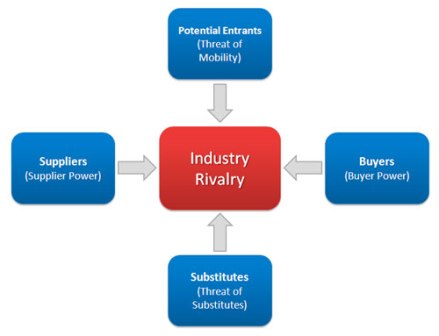
This power is somewhat restricted by platform economics. The platform does not work if the suppliers are unhappy with what they receive and similarly if the buyers are not happy with prices and service. A platform marketplace only works if the suppliers and buyers both stay and the whole business model, power, and valuation rapidly collapses if people start leaving. This sort of relationship lends itself to looking at the model from the point of Porter’s Five Forces Model

porters-five-forces-model from notesdesk

From: http://www.notesdesk.com/notes/strategy/porters-five-forces-model-porters-model/

Logically the platform would equip itself to reduce the power of buyers and suppliers in the marketplace in order to maximise its own position. For instance:

  • Attracting more supply reduces the power of suppliers.
  • Financing cars for suppliers to use (Uber) helps their suppliers with financing and cost structures but also has the Machiavellian effect of locking people into capital structures and therefore more likely to maintain supply arrangements. That reduces their choices and therefore their power.

Logical actions like this tend to concentrate innovation into the process of consolidating power and revenue to the platform rather than innovating just to delight customers. Centralised innovation tends to also limit innovation as compared to innovation on open platforms.

The sorts of actions that come with maximising the value of the platform in order to reward the founders/owners have a logical flow to them and a sense of inevitability. If you can adopt a defensive market position that give you a strategic structural competitive advantage then why wouldn’t you?

The principles around OB1 appear to be vastly different. While Fred Wilson and Union Square Ventures are likely to be holding some information back on how they plan to approach their investment for prudent financial and strategy reasons it seems they are looking to contribute to the core platform/ecosystem while opening up themselves up to out and out competition on the platform as their way of creating value for customers and investors.

A number of services could be envisaged on top of the platform that help buyers and sellers in the market place. These include search services, trust services, premium advertising services, Bitcoin hedging services, etc. However if my assessment is right OB1 will only profit if they produce the services on the platform that produce the best value for customers (buyers and sellers) and therefore they will be exposed to ongoing and relentless competition.

I see that as a fantastic thing for customers. The jury is still out as to whether such a system can compete with a more systematised and heavily capitalised platform such as eBay. On the plus side open source has proven itself again and again to be commercially competitive with companies competing on the service supply side. On the negative side simple systems that just work and employ existing standards that people are used to and trust are big winners in mass markets.

Union Square Ventures and A16Z who have also invested are smart players in this space. That does not mean they are right because they are venture capitalists who depend on the big wins to get the returns they are looking for. That means that individual bets tend to be high risk. However this is very much a space to watch

If this interests you then I suggest you read:

What is OpenBazaar?

Introducing OB1

The next post will continue on this theme and look at networks as marketplaces rather than simple paltforms

So Your Daughter Wants to be a Motor Mechanic

Myself and Christopher Rice (@ricetopher) have started writing a book on the life and work skills that a child entering their first year of high school right now will need in 15 or twenty years time. There is a lot of stuff around about the disruptive effects of technology (especially robotics and artificial intelligence) will have on work and the economy over the next twenty years but we wanted to focus on the conversations that parents are having with their teenage children about these things right now.

There are a large range of issues to consider and we will be posting examples of our thinking to this site over the next few months as we write.

As an example of this consider the situation where your sixteen year old daughter or granddaughter is considering becoming a motor mechanic. What advice would you give them.

queens auto mechanic female via nydaily news amd-audra-fordin-jpg

Picture:NYdailynews

In order to train as a motor mechanic the individual concerned must think there are reasonable chances of good employment as well as having a passion for mechanical things. Due to the length of training you would want those prospects to be long term. The prospects for a motor mechanic in 15 years time are highly dependent on a range of interacting factors:

First of all it is clear that robotics and computer technologies have had their greatest impact on routine manual and cognitive (sense making/ intelligence) jobs that can be easily automated. Think robots in car manufacturing plants, online accounting packages, or websites that now sell all sorts of travel products and services.

Secondly it is now obvious that technology is now pushing into areas that have much higher requirements for intelligence and creativity and are less routine and therefore less easily automated. Examples include driverless cars, journalism (An NPR Reporter Raced A Machine To Write A News Story. Who Won?), specialised manufacturing (Cheaper Robots, Fewer Workers), and even senior management (Here’s How Managers Can Be Replaced by Software). Recently there was even a story about machine systems rapping (Machine learning algorithms can ‘bust a rhyme’ better than humans by 21%).

Thirdly it is in the interests of business to make most work more routine because this affects the balance of power between employers and workers and therefore costs. Routine jobs require less skills and therefore on average wage levels will be lower. If wage levels are high in routine jobs they are under more risk of being replaced by technology because the economic case is better.

Fourthly there is a risk of overall disruptive change in the industry you choose to work in.

So let’s look at that from the point of view of a teenage girl thinking of becoming a motor mechanic.

Cars have clearly become more complex over the last decade and are becoming travelling computers and software platforms as much as they are a form of transport. To the extent that John Deere and GM have recently asserted that you don’t own your vehicle, you only purchased the right to use it in order to protect their software(GM says you don’t own your car, you just license it). Tesla updates its cars via software releases over the internet.

Generally one would think that increasing complexity would mean that the skills of the mechanics would have to rise and therefore it would be a good job to have. However there are several factors pushing this in the opposite direction:

  • The software systems are so complex that the job of monitoring and managing them is being increasing taken over by automated machinery that is moving towards a plug and play model that both diagnoses and fixes the car without human involvement.
  • Being a motor mechanic for specific brand of cars is essentially working in a closed system. The cars are all manufactured to a specification that is well known and understood. This means that the system you are working in is much more open to standardisation.
  • Companies such as BMW are introducing augmented reality systems that are able to recognise the car they are looking at and supply instructions and videos and augmented overlays that assist mechanics in doing their work. With massive investment and development of augmented systems around the world for a multitude of uses it is likely that these systems will rapidly improve. These sorts of technologies are very useful but they tend to lend themselves to de-skilling the workforce. If a mechanic is able to follow detailed and useful instructions overlaid on to their field of vision then there is less need for training. Less training means lower skills and easier replacement by others. Both indicators of lower wages

In the longer term the advent of driverless cars will greatly affect the job of the mechanic. There are various views on the timelines for the full scale implementation of driverless car but we view it is inevitable and likely within 15-20 years.

Currently our cars are idle about 94% of their life. The full implementation of driverless cars will mean that a large percentage of cars will be used far more as they move from transport job to transport job as de facto public transport system. Therefore the standard car is likely to do 60-100,000 km a year instead of the current 15,000 km. It also makes sense as a business model for driverless cars to be less personalised than in the past as we move from ownership to rentership[1].. Therefore very large scale model runs of cars that have greater durability and can be easily and systematically maintained make more economic sense. We will probably design cars that have lifetimes of 500,000 km but will still only last 6-8 years.

That means that the processes of fast food franchises/manufacturing plants will be applied to car servicing. This will include modularised systems that can be robotically swapped in and out of cars on a production line, with other servicing carried out on the same line Therefore skilled mechanics will be less in demand and will be replaced by a sort of basic manufacturing job.

Therefore our view is that the future job of motor mechanic for your daughter or granddaughter is much less promising than it seems currently. We would recommend that you steer that mechanically minded teenager more towards the field of robotics and drones which show much more promise and likely demand, but more on that later.

We would welcome your comments and debate

Paul Higgins and Christopher Rice

[1] A term used for moving from a system where we own most things to a greater percentage of the physical products we access being rented rather than owned.

The Budget Centrepiece: Sleight of Hand Politics and Unintended Consequences

The Australian government has made as a centrepiece of its budget a temporary change to the depreciation rules that allow small businesses with a turnover of under $2 million to write off any capital purchases under $20,000 immediately rather than over the longer term. This means that anyone who purchases such an item will create a larger short term tax deduction than they otherwise might have. Over the longer term there is no difference to the deduction as future depreciation will be reduced and tax will be higher than otherwise. The change lasts to June 30 2017.

As a futurist I am always looking at the long term impacts and the unintended consequences of actions including government policy.If we examine the possible responses from different businesses and how they will play out then we can better understand the policy.

The first group of small businesses will be those that were going to spend money on these sorts of capital items already. They will benefit from a greater tax deduction but will not have contributed any spending to the economy. The government is essentially lending them money interest free because the small business more tax back in the short term but have to pay that money back in the form of tax as depreciation is lower in the later years. Those lower tax deductions are essentially loan repayment as their tax payments to the government will be higher then than they otherwise would be. Sure they may choose to spend some of that money and stimulate the economy but it is still essentially debt based spending which has to be paid back.

The second group of small businesses are those that would have otherwise not spent the money in the next 2 years because they lacked the capital or the business case to do so. Some of these will make good decisions and some will make bad decisions given that a business capital purchase that only makes sense if there are advanced depreciation write offs is generally a marginal investment. Towards the end of the policy many purchases that were going to be made in 2017/2018 will be made before June 30th 2017 when the policy ends. This makes good economic sense for the most individual small businesses. These will be good business purchases brought forward and that brings forward the economic stimulus of those purchases. The question is what happens in the 1-2 years after the temporary change is removed. There has to be a consequence of less spending and therefore a reduction in economic stimulus at that time.

The third group is those small businesses that make spending choices based on minimising tax alone. The history of such business decisions and investments is that many of them are made poorly. Poor investment decisions are bad for the economy in general as it removes capital that could otherwise be spent on other things, reducing efficiency.

There are three major possible outcomes to the policy putting aside that micro-economic impacts might drive prices up close to June 2017 reducing the efficiency of spending decisions.

The first is that the package will work as a short term economic stimulus by promoting spending in the economy but that the spending brought forward will crash demand in the 1-2 years after June 30th 2017. The cynical would say that the government does not really care about that because it will be after the next election. However the problem may be that increased short term demand could either drive up interest rates or minimise the chances of any further rate reductions. This means that rates could be higher just as demand from small business falls away causing more problems in the economy.

The second is that the package does not work in terms of demand and that small business spending does not change much so all the government has done has lent short term money to small businesses that would have spent the money anyway. That is pure waste.

The third is somewhere in between the first two but that a significant number of small businesses that otherwise were not going to spend money  make bad spending decisions on the back of tax deduction fever. Either by spending current reserves or by borrowing money from the bank to do so. This may produce some short term economic stimulus but economic stimulus based on poor investment decisions always comes back to bite you.

The government has made a big publicity splash on this measure and the fact that they have allocated $1.75 billion to pay for it. The reality is that this is not the costs of the scheme as the only real cost is the interest on the money that the government would have otherwise received in tax receipts. The actual capital will be clawed back in future years as businesses get less deductions in the future.

Based on the media coverage so far the government has had a big political win on a measure that does not cost the budget too much over the longer term. From where I see the policy going they have achieved that political win at best for no positive impact on the economy and at worst have made another set of problems.

Paul Higgins