Is Bitcoin Technology Accelerating Faster than Anticipated

The NASDAQ has announced that they are testing use of the Blockchain technology that underpins the programmable currency Bitcoin.

On Reddit 3 days ago:

“If the effort is deemed successful, Nasdaq wants to use so-called blockchain technology in its stock market, one of the world’s largest, and potentially shake up systems that have facilitated the trading of financial assets for decades.

“Utilizing the blockchain is a natural digital evolution for managing physical securities,” said Nasdaq Chief Executive Robert Greifeld. He said the technology holds the potential to “benefit not only our clients, but the broader global capital markets.”

Nasdaq will start its pilot project in Nasdaq Private Market, a fledgling marketplace launched in January 2014 to handle pre-IPO trading among private companies. The platform has more than 75 private companies signed up, according to the company.

Private companies typically handle sales and transfers of shares with largely informal systems, including spreadsheets maintained by lawyers who verify transactions by hand. Nasdaq wants to replace that process with a system based on bitcoin’s blockchain technology.”

The Blockchain technology allows transactions to occur between two parties who do not know each other without a trusted intermediary between them.

As an example in presentations and workshops I use betting on a football game with someone you do not know. That really doesn’t happen now because how do you know they will pay up. So if you want to bet on a football game you either bet with friends or use a commercial betting agency. Those relationships provide the required trust.

However you could use the Blockchain technology to program your bet into the system and the programming includes scanning the internet for the game result and paying out on the result. The money to do this would have already been locked in the Bitcoin (or other system) currency that you own. So you can make the bet without a trusted intermediary.

Immediately this disrupts existing betting agencies but this also applies to a whole range of business models including as we can see from the NASDAQ announcement the stock market.

The initial experiment by NASDAQ makes sense because it is dealing with a sub- market that is currently clunky.

There are lots of issues still to be sorted out. In the betting example above one of the problems is the consumer standardisation of the process. The wild fluctuations in the price of Bitcoin and other currencies also means a lack of confidence in the bet amount. However we are already seeing hedging services filling this vacuum.

The NASDAQ announcement as surprised me a little. The Blockchain technology has been on my radar for a while but it is accelerating faster than I expected. Get ready for a wild ride.

Addendum: 

The again maybe I should not be that surprised. It is a general rough rule of thumb in technology adoption that a technology has to be around for twenty years before it becomes mainstream. As the history of cryptocurrency page on Wikipedia notes:

“In 1998, Wei Dai published a description of “b-money”, an anonymous, distributed electronic cash system.[17] Shortly thereafter, Nick Szabo created “Bit Gold”.[18] Like bitcoin and other cryptocurrencies that would follow it, Bit Gold was an electronic currency system which required users to complete a proof of work function with solutions being cryptographically put together and published”

Welcome to the future.

Paul Higgins

For other interesting pieces on Bitcoin and the Blockchain see

Why Bitcoin Could Be Much More Than a Currency – Technology Review

After The Social Web, Here Comes The Trust Web – TechCrunch

The Age of Cryptocurrency: How Bitcoin and Digital Money Are Challenging the Global Economic Order – Book on Amazon

The Smart Business Model Play in Solar Energy Solutions

In conjunction with the announcement by Tesla on April 30th that they are supplying home battery storage systems (Tesla launches a stationary battery aimed at companies with variable electricity rates and homes with solar panels.) Solar City in the USA has announced that

Using Tesla’s suite of batteries for homes and businesses, SolarCity’s fully-installed battery and solar system costs are one-third of what they were a year ago

Just think about that for a moment. A model which has dropped in price by 67% in 12 months. That is disruption on a major scale.

The solar panel business and the battery storage business is likely to be a continually brutal Darwinian space and require huge capital to supply the necessary scale because of the structure of the technology and the cost reductions that are occurring.

This raises the question of what is the smart play in this space and I think it is in staying away from the panel and battery technology space and playing in business model innovation at the layer above that.

There has been considerable comment on what is happening in the cost curve reductions in solar panels and battery storage including:

Why Moore’s Law Doesn’t Apply to Clean Technologies

and a counterpoint from one of my favourite analysts/writers Ramez Naam:

Is Moore’s Law Really a Fair Comparison for Solar?

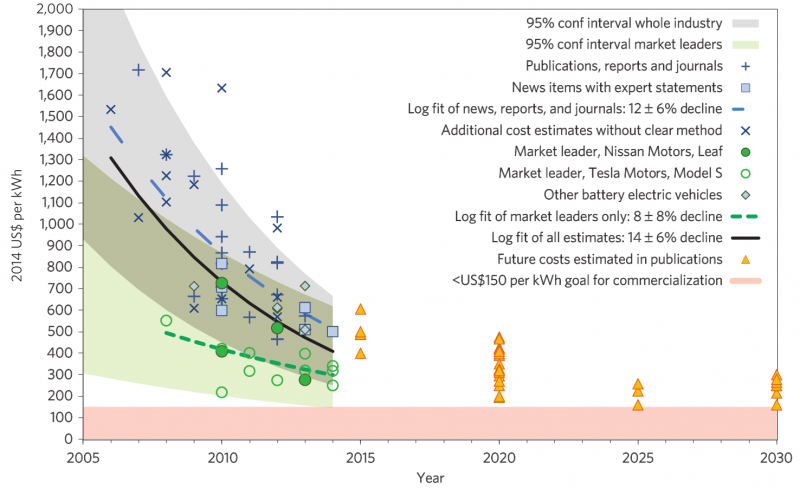
who embedded the following graphic from Nature Climate Change

Nature-Climate-Change-Batteries-Cheaper-than-2020-Projections-800x488

looking at the falling prices in battery storage.

I think both articles make excellent points but the main issue is the cause of price change over time which has been 60% annually for transistors and 14% annually for solar (over 37 years) according to Naam. Analysis of the two articles indicates that the change in transistors has been far more driven by technological innovation while the pace in solar has been more by the classic cost learning curve and move to scale.

Which brings us to the smart play. My view on the key drivers when thinking about business strategy:

  1. Just as many solar manufacturers have bitten the dust over the last decade the same will apply to battery manufacturers and start up battery companies in the next decade, as well as being a continuing issue in the panel industry.
  2. One of the main problems with Lithium Ion batteries is the charge and discharge cycle lifetime. From a cost per kWh storage point of view the shorter the life cycle then the higher the cost as the initial capital costs have to be depreciated over less energy usage. Therefore alternative battery storage options have to be a key competitor in the space. There is lots of investment going on in technology development. So to win you either have to have the capital backing that companies like Tesla boast or pick the right technology and take the development risk.
  3. Particularly at a household level the costs are related as much to installation and deployment model as to cost of the technology (just as transistors are only a fraction of smartphone or tablet costs).
  4. At the household level adoption issues beyond costs will also be critical.

So while there will be clearly winners in the panel and battery space the risks and capital required are enormous. There are better opportunities in deploying innovative business models in the space including:

  • Models for landlords that get around the issues of the landlords bearing the capital costs and tenants gaining the cost reduction on their power bills. This includes leasing and income sharing models driven by algorithms.
  • Efficient and low cost installation models that drive down the costs of installation and maintenance.
  • Financing models that allow installation for people that otherwise could not afford installation.
  • Community models that integrate use of the grid into distributed generation, storage and consumption models that reduce costs to consumers while improving the income for local generators and renewable energy systems

There are parallels for this in other sectors. The sports clothing company Under Armour is pursuing a strategy for fitness apps to complement its sports clothing sales. That strategy is hardware technology agnostic in that it integrates with a range of technologies that users are adopting. This means they do not tie themselves to any particular hardware solution and avoid riding on top of a technology that fails.

That is the smart play here

Paul Higgins

 Full disclosure: I have recently worked for the sugar milling industry here in Australia on energy transition scenarios. I may in the future have a financial interest in community models.

More Than 300 Sharks In Australia Are Now On Twitter – Is it Bad Public Policy?

Over at NPR there is a story:

More Than 300 Sharks In Australia Are Now On Twitter

(seen via Estelle Mayer)

A shark warning is displayed near Gracetown, Western Australia, in November. An Australian man was killed by a shark near the area that month, sparking a catch-and-kill order.

It commences:

“Sharks in Western Australia are now tweeting out where they are — in a way.

Government researchers have tagged 338 sharks with acoustic transmitters that monitor where the animals are. When a tagged shark is about half a mile away from a beach, it triggers a computer alert, which tweets out a message on the Surf Life Saving Western Australia Twitter feed. The tweet notes the shark’s size, breed and approximate location.

Since 2011, Australia has had more fatal shark attacks than any other country; there have been six over the past two years — the most recent in November.

The tagging system alerts beach goers far quicker than traditional warnings, says Chris Peck, operations manager of Surf Life Saving Western Australia. “Now it’s instant information,” he tells Sky News, “and really people don’t have an excuse to say we’re not getting the information. It’s about whether you are searching for it and finding it.”

This is sort of an interesting use of technology but is it good public policy and use of resources? The article quotes that 6 people have died here in Australia from shark attacks since 2011 and certainly when they occur they are tragedies for the families involved and get a lot of public coverage.

However to put this in context almost 4,000 people died on our roads from 2011 to 2013 (statistics from BITRE and the ABC). With the beach crazy culture we have I would therefore think that the risk of driving to the beach is higher than being attacked by sharks by multiple factors.

There is something primal about the the thought of being attacked by a shark and I have certainly had those feelings while surfing or ocean swimming for triathlon training. There is also something about the thought that when we get behind the wheel that we are in control as compared to sitting in a plane or being attacked in the water.

The reality is that when we enter the domain of the shark we hand ourselves over to the elements and we live in a modern controlled world where that is unusual for billions of people in cities. However we shouldn’t allow those factors to skew our view of where money should be spent to reduce loss or suffering. If we want to limit public spending by reducing tax takes and minimising our own payments as much as possible we need resources spent in the best possible way, not driven by our emotional biases.

The story of our road toll here in Australia is a great one of steady reductions with a 29% reduction from 2003 to 2012 when looked at from a fatalities/100,000 population basis. I am not an expert on these issues but I find it hard to believe that funds spent on furthering this progress would be less well spent than tagging sharks and getting them to tweet. It may be that the notification part is a small amount of a project for other reasons and therefore the spend is justified but the debate should be had.

Far too much of our public policy is driven by emotion rather than careful analysis. A case in point is climate change policy. I am a strong believer in climate change and man’s contribution to it. That also means we have to marshal our resources and spend them wisely. However there have been some crazy policies here in Australia that have been middle class welfare rather than effective climate change policies (the Productivity Commission has detailed some of these).

The effective use of foresight requires the careful analysis of policies and their possible effects in the real world and then making the hard choices. That does not mean that it is all about logic and analysis because human beings and communities do not live by logic. It does mean that logic and critical thought has to play a central part.

I will be scared of sharks when I enter the ocean, I just don’t want significant amounts of public money spent on reducing the risk or my fears. We have greater challenges.

Paul Higgins

My Best Future Thinking and Strategy Books of 2013

Here is my list of the best books I have read this year in case you need a little light holiday reading:

The Undercover Economist Strikes Back: How to Run or Ruin an Economy

As always a simple explanation of complex issues. I particularly liked the section on currency given all the issues around BitCoin at the moment

The Retail Revival: Reimagining Business for the New Age of Consumerism

Retail is under considerable pressure all around the world at the moment and this is a great book for looking at both issues and solutions.

The Everything Store: Jeff Bezos and the Age of Amazon

A fascinating read that I devoured over a couple of days. Great insights into the Amazon Business through the lense of looking at Jeff Bezos. Contacts I have had with Amazon employees indicate there is some dispute about some of the historical issues but the present day is well reflected.

Smarter Than You Think: How Technology is Changing Our Minds for the Better

I saw Clive Thompson speak at the Maker Faire in New York in September and was immediately compelled to read this book. I was particularly intrigued by his concept of video becoming the new thinking tool as a successor/complementary system to language, and paper.

The Year Without Pants: WordPress.com and the Future of Work

Another great piece of writing from Scott Berkun who describes his time in the distributed workforce at WordPress.com in a clear and entertaining way.

Moonwalking with Einstein: The Art and Science of Remembering Everything

A great story of Joshua Foer’s journey in the world of memory championships. Have used some of the techniques since reading the book.

The Antidote: Happiness for people who can’t stand positive thinking

Just had to buy this because of the title (which gives you some insight into the inner workings of my mind). A good coverage and thought provoking discussion of the issues.

Antifragile: Things that Gain from Disorder

Another book from the great and curmudgeonly Nassim Taleb. Not as good as previous ones in my view but still worth the read.

Please note that all the links to these books are Kindle book links because that is how I buy non fiction books now and I love the fact that if you really want to read one of these you can have it in 60 seconds.

In terms of fiction my two favourites for the year are:

The Windup Girl  BY BACIGALUPI, PAOLO

The Narrow Road To The Deep North  by Richard Flanagan

On my holiday reading list are:

A Naked Singularity

Dogfight: How Apple and Google Went to War and Started a Revolution

A History of the Future in 100 Objects

Not sure what that says about me and whether anyone would like to be on holidays with me but it is what it is

I hope everyone has a safe and happy Christmas and New Year and look forward to interacting with you in 2014

Paul Higgins

Reflections and Future Thinking on my Recent trip to the USA – Land of Contrasts Part 2

I have just returned from two weeks in the USA where I attended The Business Innovation Factory Summit No 9 , the Maker Faire in New York and the Mashable Social Good Summit.

In my last post I reflected on the initial stages of that trip and reconnecting with people from my trip last year. Here I am going to talk about amazing new connections I made and the rest of my trip:

Connecting with Some New Great People at BIF9

There were several amazing presentations at the Business Innovation Summit.:

Angela Maiers (@AngelaMaiers) from Choose2Matter did an amazing presentation that left many people in tears of joy on the work that she is doing with young people to make a difference and convince them they can. The video is not up yet but you can see one that she did at TED Des Moines in 2011 on the website. It was truly inspirational. Since them we have tried to get Angela out for the Nexus Global Youth Summit in Sydney where I am participating this month but we could not get the dates to match up which was a great shame but looking for next year.

Easton LaChapelle who is 17 presented on how he had made a prosthetic arm for amputees way cheaper and lighter than what is available and most of the parts were 3D printed so anyone can do them. I was sitting next to Dava Newman, professor of aeronautics and astronautics at MIT and her team were just amazed and they set out to try and hire him. I spoke to Easton later in the day and was asking about what he might do next. He said that he wanted to keep making things and he did not like it when he worked at NASA because it was too much like a desk job. A 17 year old blithely talking about how he used to work at NASA – amazing!!!

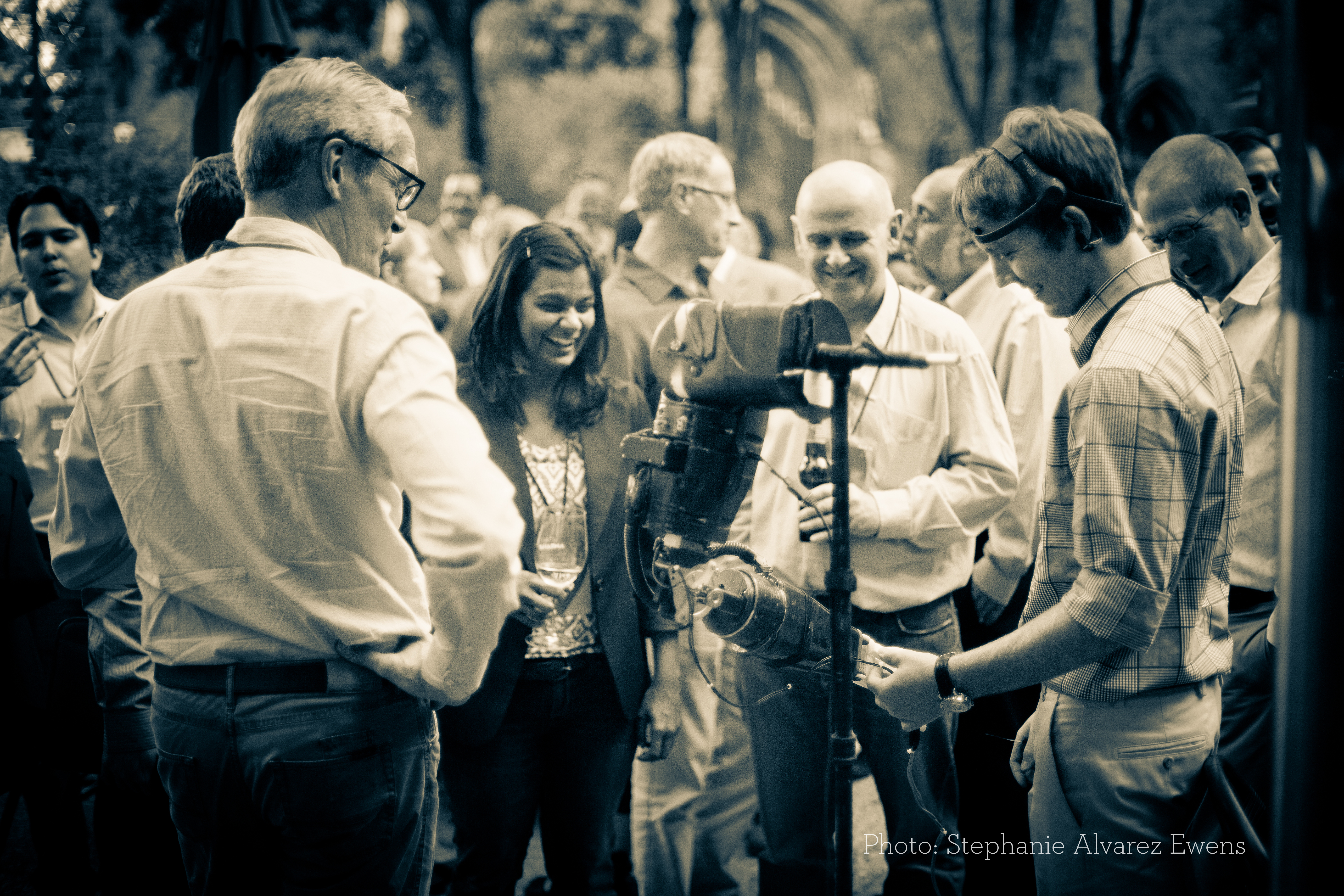
Below is Easton at the reception at the Providence Hotel after the first day at BIF9. I look old in the picture and Easton makes me feel old! The photo is one of many taken at BIF9 by Stephanie Alvarez Ewens you can see her great work by going to her gallery or by looking at the BIF9 page and looking at the photos she took there.

BIF9-SEwens-ELACHAPPELLE

Whitney Johnson (@johnsonwhitney) told a very honest and vulnerable story of her life and how she had got to where she is now. Of all the things that resonated with me at BIF one thing that Whitney said has stayed with me ever since and I have thought about it every day : “did you really show up?” as opposed to just showing up. It is a question I will take forward with me (see notes in Part 3 of of this three part blog series).

Evan Ratliff (@ev_rat) gave a really interesting presentation around storytelling and journalism and how he tried to disappear and allow people to try and find him as part of a story for Wired magazine. What really interested me was his involvement in Creativist: Storytelling without limits. This is an application that allows you to create multimedia stories and has allowed him to tell his story in a far more extensive and creative way than Wired could do. This is a great example of stuff that is in the hands of individuals or small organisations that could not have been done a decade ago without a huge organisation or lots of money behind you.  I am going to have a look at it for a couple of eBooks we are looking at publishing in a different way.

These are just a few of my highlights and my apologies to people I have left out. You can see lots more of the comments and articles that people have written since the conference by going to the BIF9 Media page.

The number, breadth and passion of these articles and blog posts and the interactions that you can see by searching for the hashtag #BIF9 on Twitter give you some idea of the excitement and enthusiasm and connections generated by the BIF summits. How many conferences have you gone to that have generated this sort of reaction from participants afterwards? I know a number of conference organisers who would kills for this sort of reaction. More importantly people are getting together and doing stuff together as a consequence of connecting at BIF. That is where the real value that is generated and the long term Machiavellian aim of Saul Kaplan, the leader of the team at BIF.

As an example @sandymaxey was not at BIF9 but was hooked in online via the steaming and via Twitter. We connected up and have already started a conversation on how we work together on efforts in regional communities in Australia and the USA over the next year. That is part of the ongoing legacy that BIF creates.

I intended for this to be a two part post but it has become bigger than that so I will leave the rest to a third post which will be around:

The Maker Faire and my day with Lynda Koster

My Disappointment at the Mashable Social Good Summit

My plans for the year

As a teaser for the third line in part 3 below is the graphic representation of some of that focus that @jesch30 did for me which is now up on the wall in my home office and driving me forwards

jess picture snapshot on office wall

Reflections and Future Thinking on my Recent trip to the USA – Land of Contrasts Part 1

I have just returned from two weeks in the USA where I attended The Business Innovation Factory Summit No 9 , the Maker Faire in New York and the Mashable Social Good Summit.

The reason I say land of contrasts in the title of this post is because I love going to the USA. I love the people there, I love the feel of the place and I saw some amazing things and connected with some amazing people on my trip. At the same time I am amazed and dismayed by the politics, the rising levels of inequality and the recent problems around health care which have resulted in the Federal Government shutdown.

I think that this is best visualised by this blog post I re blogged on our Tumblr scanning site from Cory Doctorow which involves a Jon Stewart Daily Show rant on the shutdown and some really heartfelt comments from people on who will be most affected:

Tumblr Post on The Shutdown in the USA

It is hard to understand from here in Australia is that healthcare is not universal and the shocking stories of the high levels of personal bankruptcy due to medical problems.

Anyway enough of the problems here are some highlights out of the many. The positive far outweigh the negatives:

Meeting Stowe Boyd Face to Face

Stowe (@stoweboyd) and I have been connected over social media for a long time now and I read most of what he writes. I am particularly interested in his concepts of collaboration versus cooperation as elaborated in two great posts: The future of work in a social world: part 2 (you can access the first one from this article). I visited him at his home in Beacon New York and we went out for pulled pork quesidillas and great conversation on all sorts of things. He is a deep thinker and creator of great frameworks. I  am planning on using him in a project we are starting here in Australia and I look forward to many more interactions. It was great to meet in person – you can do all the internet stuff you like but until you break bread together and  discover for instance that you are both early risers and nappers you do not really connect. I recommend you go and follow him and read his stuff. Your thinking will be the richer for it.

Attending BIF9 and Re-Connecting With Some Great People

I went back to the Business Innovation Summit after attending last year keen t defend my “most miles traveled award”. It was my great pleasure to connect up again with Jess Esch (@jesch30) and Anita Crofts (@avcrofts) who both took me under the wing last year and looked after me when I did not know anybody. They both do great stuff. Jess works with United Way but is also a graphic artist/illustrator. She did my twitter avatar which you can see over at @futuristpaul. Since I have returned to Australia Jess has helped me with focus for the year ahead. She does this thing where you talk about what you want to achieve and she draws it out while you talk. I have the two she did  for me over Skype on my office wall in front of me as I write this. It is much more inspiring and focusing than a written list.

Anita is doing amazing things in education which you can see at : Want to Learn How to Fly? . I intend to pick her brain on some of the projects we are involved in around leadership in a digital age and community collaboration. She had one of her students with her who was so enthusiastic and passionate about what Anita had done for her career it was amazing

I also reconnected with Christopher Rice (@ricetopher) who is a fellow futurist who probably thinks a little too much like me to be completely sane.  He is committed to education and communities and rethinking how futurists help their communities. We plan to hook up regularly and try and rethink these things together – should be great fun.

I also reconnected with Matt Murrie (@MattMurrie) from What If. Matt and his team sat down with me after the summit to discuss future thinking and how they could apply it to what they are doing. I think I waffled too much but hopefully it helped because they have the potential to do some great things. Matt also posted a story at Huffington Post where he talked about his BIF experience:  What If @ BIF?

The BIF summit is a fantastic collection of people who form a community that connect with each other and actually get things done outside of the the conference itself. I recommend everyone take a look at it and see for themselves. The videos form last year are up at http://www.businessinnovationfactory.com/iss and this years will be up soon.

Overall my experience of the trip and America was highly positive. When you met with the people I met with and saw the amazing things they are doing it give you great hope for the future. Maybe the USA can just ignore Congress and the Senate and be a bit like Italy – just get on with it regardless. Sadly The federal Government seems more dysfunctional than the chaos of Italian governments since World War 2.

In my next post I will talk about:

Connecting with Some New Great People at BIF9

The Maker Faire and my day with Lynda Koster

My Disappointment at the Mashable Social Good Summit

Digital Natives v Offline-Borns

I saw this article on the web this morning and it got me thinking:

Why Can’t Offline-Borns Tell Difference Between Voluntary and Forced Actions?

Image

The article is interesting in its own right, commenting on privacy in the light of the US Prism revelations.

However what struck me was the term “Offline-Borns” which I had not come across before although I have been regularly using the terms “Digital Natives” (coined I believe by Marc Prensky) and “Children of the Screen” (not sure of the origin) to describe post internet born people, and post smartphone/tablet generations.

What struck me was that the term appeared divisive and almost derogatory even though it was descriptive in a similar way to the terms that I have using to talk about other “generations”.

I have been giving guest lectures at Victoria University about the disruptive nature of web technologies and one of the interesting things about that was that most people in the room were not born before the world wide web was created.I was happy to do that because as Marshall McLuhan talked about one of the difficult things to do is to analyse and think about an environment you are immersed in – he used the analogy of fish and water or humans and air. Therefore I believed that I could provide a valuable perspective for the students to think about.

The question this article posed for me is : “Have we reached a state where the clear distinction between online borns and offline borns is creating a significant divide in our societies that threatens cohesion and communication beyond standard generational difference?” This of course is a perspective largely for a modern developed economy and naturally poses different questions in other parts of the world.

I would be interested in thoughts.

Paul Higgins

Futurists, What are they good for?

An article was published today in the Sydney Morning Herald about futurists:

Grappling with the day after tomorrow – Futurists are struggling with mixed fortunes in their field of commerce.

I was interviewed for the piece in August last year and am mentioned in passing via a quote about my work from one of my key clients, the YMCA. The article starts off :

“Soothsayers, pundits, fortune tellers and a long history of failures have given predictions a bad name. So why do otherwise intelligent people continue to stake their profession on predicting the future?”

and continues in a similar vein. I would like to take issue with several points made in the article. I encourage you to go and read the whole article so you can judge for yourself if my comments are made in context:

1/ “Australian futurists reckon their chosen field is moving from the kooky fringe to the commercial mainstream”

I would be very surprised if any of the professional futurists mentioned in this article would consider the field as being regarded as kooky. However the article is written in a way that implies that. I would certainly agree that there are kooks and charlatans who try and predict the way things will be. My advice to clients and audiences who ask what the future of a certain industry might be in ten years is that I will guarantee only one thing : “that such a view will be wrong” That does not mean it is not useful to think through what the future might be. It is just that in a  complex and fast moving world long term predictions mostly don’t work. I have written and spoken a fair bit on the fallacies of forecasting. If you are interested you can read more on this by going to:

How to pick a good Futurist from a snake oil salesman

2/ “BHP Billiton, Telstra, Westpac, Western Power, MLC, Foster’s Group, BNP Paribas Australia and Sara Lee are among scores of companies named as clients on futurists’ websites, though in many cases this may mean only that they have had a futurist in as a guest speaker……………Inquiries to several other firms about their engagement of futurists yielded coy responses, though Telstra confirmed it engaged futurists ”from time to time to assist with various areas of our work”. Colliers International, St George Bank and the NRMA were among companies listed as clients on futurists’ websites that professed no corporate memory of it when contacted.

I have not worked with any of these clients so this does not refer to me specifically. Our work is divided roughly into about 1/3 speaking engagements, 1/3 short consulting engagements, and 1/3 longer strategy engagements which may last up to about 18 months. It seems like sloppy “gotcha” journalism to call a very large company and ask for their response on a particular project. The spokesperson has no interest in following up such a request diligently and the process seems designed to get the answer that was written rather than to properly assess worth of the foresight practitioners involved.

3/ “Those who do admit to working with futurists speak of the benefits in vague terms”

As I am referred to in the paragraph after this statement I thought I should respond in more detail. As the work we do is primarily focused on assisting others to think differently about the future it is less able to be quantified as compared to a change management process,or a sales training program, or a software delivery project. I often think about a presentation that I saw Edward de Bono do a few years ago where he likened the process of innovation in ideas being like telling a good joke. Before you tell a joke the punchline and the thread of the story are not obvious. After the joke has been told they are. Helping people in finding new possibilities is a bit like that. Once the idea or the strategies have been created they often seem obvious in retrospect and therefore allocation of credit in a quantitative way is impossible. We worked for a client last year in generating a wide range of new possible ideas given possible changes in the future. When these were presented to the CEO by the senior manager who had worked with us he said ” I could have thought of these”. To his credit the senior manager had the courage to respond “but you didn’t did you, and if it is that easy give me two more right now”. To which there was no reply.

I come from a background in science and research and farm animal production ( I have a First Class Honours Degree in Vet Science and a Bachelor of Animal Science for research into poultry diagnostic tests). In addition I grew up in a household that was steeped in analytical processes and measurement given my father has a PhD in Metallurgy, one of my brothers is an engineer and the other holds an MBA. In all of that background and work analytical processes and measurement of results were vital, and in fact it was one of the things that attracted me to the fields I became involved in. However the training I received in doing my Masters Degree in Strategic Foresight widened my horizons and my skill sets and we have to recognise that not all things are measurable in the same way. We should always seek to measure results but we must also accept that quantitative measurement of some things is impossible. My key measurement of our success is that apart from some Google Adwords advertising as a conference speaker we do no advertising. All of our work comes from word of mouth and references from existing clients. That would not happen if we were not providing value to those clients.

4/ “The sweet spot on which futurists depend for most of their living is 10 to 20 years hence. It is seen as a comfortable psychological space in which the futurist’s best stab at where things are headed is accepted as plausible and the client can plan to make the necessary changes”

I can only speak about the work that we do but 10-20 years tends to be too far away for practical value in my view. Our work has changed over the last decade to be far more focused on how do you create a strategy which deals with the fact that forecasting does not work and that “best stabs” are somewhat useless. You can read more on our approach by looking at:

How to make Strategy SEXy

5/ “Susan Oliver, the only Australian futurist invited to Kevin Rudd’s Australia 2020 Summit, insists on the case for futurist approaches but says it is getting harder in practice. ”I am not sure that we can engage in long-term planning because the world is changing too quickly in unpredictable ways,” she says. By this logic, the futurists who see rapid change as their meal ticket may be confusing their preferred with their probable futures”

Given the problems around the future summit I was probably lucky not to be invited. Our work centres around helping people deal with that rapid change and our job is to use tools which are appropriate to what is happening, not pick the tools first. This last statement in the article is a bit of a smartarse one liner that might good for a laugh but demeans what should have been a decent critique of the field of futures studies and futures consulting. It is a shame that such a decent critique did not take place.

I remember sitting in a room of graduates when a well known international futurist came to visit Swinburne University. There was a lot of bemoaning by the graduates that “we are not listened to enough and we should be because we do great work.” In response after listening for a while I said ” well maybe no-one listens to us because we are not that good at what we do?” There was complete silence in the room and the discussion went back to complaining about the lack of foresight and long term thinking in the community and with clients. Putting that aside (which has some truths to it)  I would like to make some contributions to the critique:

1/ I think there are problems because the role/job of foresight practitioners/futurists is too ill defined. The range of what we do merges into what people would define as strategy or management consultants. Unfortunately that is probably not going to change much because I am firm believer that we have to continue to change and evolve in relation to the needs of clients and the community. If you are a vet people mostly know what you do. If you are a futurist it is never going to be the case. We just have to suck it up.

2/ I think there is far too much emphasis by futurists on forecasts or in the case of the approach described by Phil Ruthven in the article on long term trends and historical cycles. People such as author Jim Collins (Good to Great, etc) make a tremendous amount of money analysing companies historical performance and then distilling the practices that supposedly achieved that great performance. The trouble is that by the time that data is collected and analysed things have changed. There have been several analyses of performance of the target companies after the studies have been done and many companies highlighted as great actually under perform in subsequent periods (anyone interested in looking that this further should read The Halo Effect by Phil Rosenweig).To be fair on the forecasting front the SMH article did mention Philip Tetlock’s work on forecasting which is a great critique of the problems with forecasting.

3/ There is a tendency (and I would include me in this category) not to challenge clients enough. In the interests of maintaining consulting income or with the flimsy excuse that “we will get in their first and then change after the first lot of work gives us entry” we do not push people to think hard enough to think differently and challenge the status quo view of the future. We are trying to change that by having an internal business model rule where we intend to reject about 1/3 of the clients that approach us on the basis that they are not pushing hard enough to think differently and are not willing to be challenged. We also push in our keynote presentations -see The Provoker for a description of that style. In recent feedback at a conference I was scored just above 8 out of 10. Analysis showed that almost 1/3 of the audience gave me 10 out of 10 but 10% gave me 1 out of 10. That is a response we actually look to achieve because unless some people reject an idea or a way of thinking it is not radical enough to move others to action. The profession needs more  of that I think. Anyway that is enough of a rant from me, I would be interested in other people’s point of view

Paul Higgins
Which of the Dinosaurs will Survive?

The Guardian newspaper has launched an online Australia version of its newspaper:

Guardian Australia launches with promise of ‘fresh and independent view’

In my view this is part of the future of newspapers and marks the continuation of what I see as a major extinction event where there will be a further massive loss of newspapers around the world. This is due to continuing evidence that digital pay models and digital advertising are not replacing the old business models in terms of revenue per reader. Therefore I think that the media landscape in general and newspapers in particular will divide into a few distinct business models:

1/ The Global Giants.

There will be some very large newspapers that will survive and prosper and they will do so by reaching a much larger global audience and therefore garnering enough revenue to maintain good levels of quality, stories and investigative journalism. The Guardian is an example of one of these that may survive and the story they have done on the bushfires in Tasmania, Australia is a case in point:

Firestorm

A compelling story, told in a superb and mesmerising way that has local content and interest but also has a wider global audience and interest.  That global audience includes those that have bushfires issues in their own communities but also those people interested in great human interest stories. It also not a “normal” newspaper story.

The key initial ingredient that the newspapers have that might survive with this business model is a great and trusted brand. So newspapers like the New York Times, The Times, and The Guardian are good candidates.

However that great and trusted brand is only a ticket to play in the game and does not guarantee survival. A lot of well known newspapers are going to try this strategy and only a few will survive. Two other key components are going to be required. The first is continual investment in the assets required to tell great stories – journalists. The second is patient capital because this is going to be a long and bloody fight and the organisations involved will need deep pockets:

NOTE: The Guardian bushfire story was notified to me by Michael Cote who is a climate adaptation consultant and runs a blog on Tumblr (Climate Adaptation) where I follow him. This is a mark of how these stories will be accessed and promoted in the future. A story about my country was relayed to me by someone I have never met who lives in Massachusetts.

2/ National Champions

These are the newspapers/media outlets that will survive by focusing on key national issues that are not of interest to a wider global audience. Their stories will include stories at a national politics levels and investigative journalism focused on national politics and local corporate issues as well as sport which appear to drive a huge amount of “eyeball” to use the jargon.

I think that the model of ow this will work will be far more varied. Possibilities include the creation of crowd funded journalism models where people agree to fund specific investigative journalism. They also include the loyal readership of such a newspaper/media outlet being an asset that can drive revenues into the larger global entities that survive and generate income by doing so.

3/Local/Specialised

This is going to be much more fragmented and localised and also far more prone to non profit business models. The development of web based technologies has made both the creation of content, and the connection to an audience much more effective and has vastly reduced the costs. That will allow a continual flowering of new models and possibilities.

A journalist friend of mine is always talking to me about how important a strong and independent media is to the strength of our countries and our communities. I totally agree with him but a “you will miss us when we are gone” has never been a great value proposition.

There is going to be lots of churn and extinction in this space and I think we all have a responsibility to think about how this will all work. I for one am keen to support crowd funded investigative journalism models as part of my contribution.

Paul Higgins

The Rise and Rise of Social Enterprise (and the bloodbath that precedes it)

I spoke to a group of assistant commissioners and deputy assistant commissioners in the Australian Tax Office yesterday on issues that might affect their future workforce strategy.

One of the issues I raised was the rise of social enterprise. I define this model as an organisation that has both a profit driven business model and a social mission.

In my work and interactions with the not for profit sector I am seeing a number of factors that are coming together to fuel what I see as the inexorable rise of the social enterprise model.

The first of these is that not for profit organisations are coming under increasing financial pressure as the global financial crisis grinds on. These pressures are coming from a number of directions:

  • Corporate sponsorship is under increasing pressure as companies look to cut costs.
  • Corporate volunteer programs are under pressure as employees are more concerned about keeping their jobs than contributing to the corporate social responsibility programs of their company.
  • Philanthropic organisations are seeing their capital bases eroded at the same time as an increase in funding applications.
  • Governments are seeking to reduce expenditures in all sorts of areas, either as austerity measures or for political messaging purposes.

As a result that has been a surge of interest from not for profit organisations looking for opportunities in social enterprise as a way to create a more stable funding base.

It is my very strong view that a well run social enterprise model has a competitive advantage over a commercial business operating in the same space. As a customer I will spend money at a social enterprise business over a commercial business but only if their product or service is equal or better to that of the commercial business. Sadly many of the social enterprises around the place (with some notable exceptions) are relying too much on people spending money with them because they are doing good things rather than being the best business in the sector or space.

Those that can match a great profit driven business model with a social mission can create a competitive advantage that is almost unassailable. This is because they have an advantage with both customers and their staff. If two products or services are of a similar quality and I can support my community by spending my money at the social enterprise that supplies them rather than a commercial business why wouldn’t I do that? If I want to live my life with purpose and making a contribution to my community and can be paid the same amount of money at a commercial business or social enterprise business which am I going to choose?

Which brings me to the bloodbath part of this story.

There are two parts to the bloodbath, one that is is chaotically destructive and the other one that will continue to underpin the rise. One is short term and painful and the other is permanent and constructive.

The chaotic part is that in my view a lot of not for profit organisations that are poorly equipped to enter the social enterprise are doing so because they are being driven by a financial crisis imperative rather than a strategic one. Running an excellent business model in a social enterprise or a commercial enterprise is hard and requires different skills than a not for profit organisation. This means there will be lots of serious failure in the space over the next five years. That will be difficult but what emerges will be stronger.

I believe I saw a component of the permanent and constructive model this week when I attended an evening of the LV Foundation as part of my involvement in Leadership Victoria. The Foundation hosted a presentation by Lance Fors the Chairman of Social Venture Partners International which is a group looking to support not for profit organisations and social enterprise by taking some of the lessons learnt in the start-up and venture capital world. They are doing so by providing grants, by providing loans, and by investing in social enterprises. On top of that they are also providing their expertise.

The part of Lance’s presentation that struck me as most important was his view about risk and that the sector was not taking enough risks and therefore not being innovative enough and that SVPI was looking to change that. His view was that if the sector was not failing enough then they were not pushing the boundaries of what could be achieved.

The “creative destruction” that occurs in the venture capital and start-up ecosystems is what has underpinned the amazing flowering of innovation we have seen in the technology sector in the last decade. The sort of model that SVPI uses and promotes has the potential to do the same in the social enterprise sector. I for one think that is fantastic and I have put my name down to be part of the group looking to be part of the model here in Melbourne.

If anyone else is interested then just tweet me : @futuristpaul and I will put you in touch with the organisers.

The social enterprise space is certainly one we will observing closely for signs of innovation and change.

Paul Higgins