The Smart Business Model Play in Solar Energy Solutions

In conjunction with the announcement by Tesla on April 30th that they are supplying home battery storage systems (Tesla launches a stationary battery aimed at companies with variable electricity rates and homes with solar panels.) Solar City in the USA has announced that

Using Tesla’s suite of batteries for homes and businesses, SolarCity’s fully-installed battery and solar system costs are one-third of what they were a year ago

Just think about that for a moment. A model which has dropped in price by 67% in 12 months. That is disruption on a major scale.

The solar panel business and the battery storage business is likely to be a continually brutal Darwinian space and require huge capital to supply the necessary scale because of the structure of the technology and the cost reductions that are occurring.

This raises the question of what is the smart play in this space and I think it is in staying away from the panel and battery technology space and playing in business model innovation at the layer above that.

There has been considerable comment on what is happening in the cost curve reductions in solar panels and battery storage including:

Why Moore’s Law Doesn’t Apply to Clean Technologies

and a counterpoint from one of my favourite analysts/writers Ramez Naam:

Is Moore’s Law Really a Fair Comparison for Solar?

who embedded the following graphic from Nature Climate Change
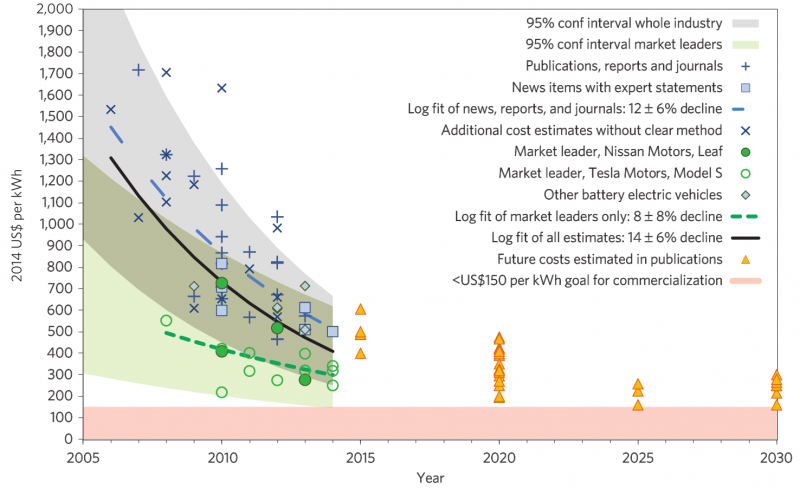
Nature-Climate-Change-Batteries-Cheaper-than-2020-Projections-800x488

looking at the falling prices in battery storage.

I think both articles make excellent points but the main issue is the cause of price change over time which has been 60% annually for transistors and 14% annually for solar (over 37 years) according to Naam. Analysis of the two articles indicates that the change in transistors has been far more driven by technological innovation while the pace in solar has been more by the classic cost learning curve and move to scale.

Which brings us to the smart play. My view on the key drivers when thinking about business strategy:

  1. Just as many solar manufacturers have bitten the dust over the last decade the same will apply to battery manufacturers and start up battery companies in the next decade, as well as being a continuing issue in the panel industry.
  2. One of the main problems with Lithium Ion batteries is the charge and discharge cycle lifetime. From a cost per kWh storage point of view the shorter the life cycle then the higher the cost as the initial capital costs have to be depreciated over less energy usage. Therefore alternative battery storage options have to be a key competitor in the space. There is lots of investment going on in technology development. So to win you either have to have the capital backing that companies like Tesla boast or pick the right technology and take the development risk.
  3. Particularly at a household level the costs are related as much to installation and deployment model as to cost of the technology (just as transistors are only a fraction of smartphone or tablet costs).
  4. At the household level adoption issues beyond costs will also be critical.

So while there will be clearly winners in the panel and battery space the risks and capital required are enormous. There are better opportunities in deploying innovative business models in the space including:

  • Models for landlords that get around the issues of the landlords bearing the capital costs and tenants gaining the cost reduction on their power bills. This includes leasing and income sharing models driven by algorithms.
  • Efficient and low cost installation models that drive down the costs of installation and maintenance.
  • Financing models that allow installation for people that otherwise could not afford installation.
  • Community models that integrate use of the grid into distributed generation, storage and consumption models that reduce costs to consumers while improving the income for local generators and renewable energy systems

There are parallels for this in other sectors. The sports clothing company Under Armour is pursuing a strategy for fitness apps to complement its sports clothing sales. That strategy is hardware technology agnostic in that it integrates with a range of technologies that users are adopting. This means they do not tie themselves to any particular hardware solution and avoid riding on top of a technology that fails.

That is the smart play here

Paul Higgins

 Full disclosure: I have recently worked for the sugar milling industry here in Australia on energy transition scenarios. I may in the future have a financial interest in community models.

Major Disruptors of the Next Decade Section 3 – The Uber Pivot

This is part of a larger series on major disruptors. You can see the previous post in the series at:

Major Disruptors Section 2

The posts so far have focused on both the gains to be made from driverless car technology and the disruptive effects of that technology on various industries and landscapes. The next post was supposed to be on opportunities from driverless cars rather that disruptions. That post will be along soon but meanwhile lots of people have been asking me about the Uber business model in relation to driverless cars.

Uber has worked by displacing the taxi industry to a certain extent by harnessing unused capacity in vehicles in our communities but also by bypassing regulation and maximising the use of application and location technology. Given that the company has been valued at US$18 billion according to its latest funding round, (Taxi app Uber valued at $18 billion in new funding round) and my view that driverless car technology might be fully implementable in 10 years the question has been how does the company valuation make sense when the model is likely to be completely wiped out?

Firstly I think that the business model does have some short to medium structural problems. It is highly possible that the taxi/driver based car system is the one that will be initially replaced in the implementation of driverless cars. If this becomes clear then I think that Uber will have trouble retaining drivers and gaining new drivers in the transition period before the implementation period becomes practical. Who is going to invest in a vehicle or throw in their job, or turn down a job if they are likely to be replaced in one or two years. This is is similar to the problem that the car manufacturing industry will have close to a full scale implementation that I mentioned in my initial post.

The second issue is one that a lot of companies are facing right now and more will in the future. In a world that is changing more rapidly and where disruptive business models or technologies can turn up from anywhere how do you maintain a strategy and a profitable business model that has longevity? Market valuations are supposedly based on the forward view of cash flows (market irrationality aside). In a world where you business model only lasts for 10 years or less how do you maintain a valuation, especially if those cash flows are negative while you rapidly expand? The only way that Uber can do this is a long term vision of pivoting their business model significantly and that model has to be one of being a significant player in driverless car models. In the meantime they have to maintain a profitable or funded model that makes sense to people. In the longer term the game has to be one of using that platform to accrue a huge amount of data and expertise around customers and their travel requirements. It may seem crazy to have a 10 year plan to expand to hundreds of cities just to create a new business in the future but that is what is necessary in these times for lots of businesses. To me it is the only way that the current valuation makes sense.


What is your business model/strategy to deal with these sorts of issues given that as Gary Hamel has said “somewhere someone is making a bullet with your business’ name on it”.


Medium, Tumblr and Community Based Business Models

It has been a while since I wrote something here. Life has been getting in the way. However I noticed something form my colleague and friend Stowe Boyd which stimulated me to respond. Over at Tumblr Stowe posted:

Medium becomes more Tumblrish

Hamish McKenzie noted that Medium had become significantly more of a curated experience  in its recent facelift. But I think in his positioning of Medium and Flipboard as two competitors for our attention, he misses something important

He concludes with:

“I find it interesting that Tumblr seems to be changing so slowly — hardly at all — since being acquired by Yahoo. And one of the obvious ways to draw more interest to Tumblr would be the simple avenue of making the curated topics a/ public and b/ better looking. Right now they look like the (relatively unappealing) Tumblr dashboard, and there is little or no room for advertisements.”

“But I have made several of the curated topic feeds — like Tech and Design — a part of my central daily practice. I have not done that with Medium, although I do use Flipboard every day, too”

You can read the whole post by going to: http://stoweboyd.com/post/69485777176/medium-becomes-more-tumblrish

My response to this is:

I am one of the Tumblr tech curators/editors and I am not sure about how I feel regarding advertising on the curated areas of Tumblr. On the one hand I can understand the appeal and like Stowe have made looking at the curated areas part of my daily information practice. I can also understand that the service needs to make money to sustain itself and I am supportive of that as long as it is done in a way that is not intrusive on the reader/community. On the other hand I am somewhat leery of Tumblr/Yahoo making money on top of my voluntary efforts. I would need to balance off that against my view of my contribution to the community and also any value I feel the extra profile of a public and promoted page may do for me and our business.

This is the delicate balance of some of these new business models where the community is producing the product. Too delicate an economic business model may imperil the economic viability of the service, and too intrusive a model may damage the goodwill of the community and therefore make the whole thing evaporate or at least to a level that is non viable. Fundamentally I think that this is easier outside of a large company where transparency can allow the community to make finer grained judgements about the economic model and what it is delivering as long as it is transparent. That is much harder inside a larger company that tends not to publish data on the individual performance of its parts in a way that is clear for everyone to see.

I would be interested in comments.

Paul Higgins

Which of the Dinosaurs will Survive?

The Guardian newspaper has launched an online Australia version of its newspaper:

Guardian Australia launches with promise of ‘fresh and independent view’

In my view this is part of the future of newspapers and marks the continuation of what I see as a major extinction event where there will be a further massive loss of newspapers around the world. This is due to continuing evidence that digital pay models and digital advertising are not replacing the old business models in terms of revenue per reader. Therefore I think that the media landscape in general and newspapers in particular will divide into a few distinct business models:

1/ The Global Giants.

There will be some very large newspapers that will survive and prosper and they will do so by reaching a much larger global audience and therefore garnering enough revenue to maintain good levels of quality, stories and investigative journalism. The Guardian is an example of one of these that may survive and the story they have done on the bushfires in Tasmania, Australia is a case in point:

Firestorm

A compelling story, told in a superb and mesmerising way that has local content and interest but also has a wider global audience and interest.  That global audience includes those that have bushfires issues in their own communities but also those people interested in great human interest stories. It also not a “normal” newspaper story.

The key initial ingredient that the newspapers have that might survive with this business model is a great and trusted brand. So newspapers like the New York Times, The Times, and The Guardian are good candidates.

However that great and trusted brand is only a ticket to play in the game and does not guarantee survival. A lot of well known newspapers are going to try this strategy and only a few will survive. Two other key components are going to be required. The first is continual investment in the assets required to tell great stories – journalists. The second is patient capital because this is going to be a long and bloody fight and the organisations involved will need deep pockets:

NOTE: The Guardian bushfire story was notified to me by Michael Cote who is a climate adaptation consultant and runs a blog on Tumblr (Climate Adaptation) where I follow him. This is a mark of how these stories will be accessed and promoted in the future. A story about my country was relayed to me by someone I have never met who lives in Massachusetts.

2/ National Champions

These are the newspapers/media outlets that will survive by focusing on key national issues that are not of interest to a wider global audience. Their stories will include stories at a national politics levels and investigative journalism focused on national politics and local corporate issues as well as sport which appear to drive a huge amount of “eyeball” to use the jargon.

I think that the model of ow this will work will be far more varied. Possibilities include the creation of crowd funded journalism models where people agree to fund specific investigative journalism. They also include the loyal readership of such a newspaper/media outlet being an asset that can drive revenues into the larger global entities that survive and generate income by doing so.

3/Local/Specialised

This is going to be much more fragmented and localised and also far more prone to non profit business models. The development of web based technologies has made both the creation of content, and the connection to an audience much more effective and has vastly reduced the costs. That will allow a continual flowering of new models and possibilities.

A journalist friend of mine is always talking to me about how important a strong and independent media is to the strength of our countries and our communities. I totally agree with him but a “you will miss us when we are gone” has never been a great value proposition.

There is going to be lots of churn and extinction in this space and I think we all have a responsibility to think about how this will all work. I for one am keen to support crowd funded investigative journalism models as part of my contribution.

Paul Higgins

Music Industry Whinges or Music Industry Whinges?

An interesting article at the New York Times entitled As Music Streaming Grows, Royalties Slow to a Trickle talks about streaming services and their income payments to artists including:

“Late last year, Zoe Keating (pictured) , an independent musician from Northern California, provided an unusually detailed case in point. In voluminous spreadsheets posted to her Tumblr blog, she revealed the royalties she gets from various services, down to the ten-thousandth of a cent.

Even for an under-the-radar artist like Ms. Keating, who describes her style as “avant cello,” the numbers painted a stark picture of what it is like to be a working musician these days. After her songs had been played more than 1.5 million times on Pandora over six months, she earned $1,652.74. On Spotify, 131,000 plays last year netted just $547.71, or an average of 0.42 cent a play.”

The article raises a number of important issues but also seems to speak from a sense of the music companies protecting their turf and musicians being entitled to a living.

One of the constant themes in my conference presentations and my talk to University students on the disruptive effects of web technologies has been the removal of the gatekeeper. I commonly describe this gatekeeper as a bunch of middle aged white men making decisions about what the consumer will get to listen to or get to see.

I see this removal of the gatekeeper as one of the great things of the 21st century and the ability of the any creator of “stuff” being able to connect to anyone in the planet as a fantastic development. There is a lot of hand wringing in the music industry about these issues but I see them as mainly a self protection mechanism rather than any real concern about the musicians.

I think that we are likely to see the following:

  • More and more musicians connecting to their fans in a number of ways including streaming services.
  • Streaming services beating the ownership model in most cases.
  • An increase in the total spend on music as more and more people are connected.
  • The average income per musician/band falling because people will be exposed to far more music than the gatekeepers let people listen to. Total number of bands and musicians available will grow faster than total income.
  • Breakout bands and hits still commanding good money.
  • Innovative approaches and musicians finding ways to make all this work – a la Amanda Palmer on Kickstarter.

I am confident that market mechanisms will sort out the issues and that if streaming services try to pay little in the long term then other services will spring up to take the space.

I would like to end with the Hunter S Thompson quote on the music industry:

“The music business is a cruel and shallow money trench, a long plastic hallway where thieves and pimps run free, and good men die like dogs. There’s also a negative side.”

The new way has to be better than that

Paul Higgins

How to make Strategy SEXy

When I tell people that I am a futurist the reactions fall into two broad categories.

  • “That is so cool” – to which my response is generally “can you go and tell my 15 yr old because he in no way thinks I am cool”.
  • What the ****** is a futurist. That happened to me yesterday when I was sitting in the audience for the launch of a new Horizon Scanning tool that we are working on with the Department of Premier and Cabinet here in Victoria. The group in the seats behind me were saying “what is a futurist, there is supposed to be one here?” My general response to that reaction is : we help people think differently about the future so they can shape their strategy.

I like to show people the Futurist Meme from http://www.wfs.org/content/what-people-think-i-do-meme-futurist

because it is largely true from a number of perspectives and I do like to think that what I do is about helping people get a few more pieces of the puzzle about what the future might hold.

Because the future is inherently unknowable we need to take the possibilities that we see and put them into a forward strategy because while the world is highly uncertain, complex, and rapidly changing we still need to do stuff.

To do that we use the acronym SEX for strategy. Partly because it is easy for people to remember  and partly because sex is sort of involved. Sex stand for Strategy, Experimentation, and eXploration.:

Strategy

Strategy is about what we know enough about to create a hard, detailed plan. This can be the case even in the face of considerable uncertainty. For example if we look at agricultural research in the face of climate change there is a huge amount of uncertainty. Even if we put aside the arguments between those that believe in climate change being largely man -made and those that do not there is still considerable uncertainty in the macro models. Beyond that once we drill down into specific geographical regions the uncertainty is much higher. In the face of that uncertainty research into improving the water utilsation of plants is still very useful. If climate change does not occur then those plants will still be useful in areas that were previously too dry to grow them. If the actual regional outcomes are far different that the median models then the plants will still be useful somewhere, even if it may be far away from what was envisaged when the research began. Strategy is about creating a detailed, defined plan that fits how the organisation actually works rather than fitting the organisation to the plan. It is also about finding things to do that are successful in multiple forward scenarios.

Experimentation

The reality is that we live in a complex, rapidly changing and uncertain world. Most people respond to that  by trying to create certainty through forecasts or spreadsheet models derived from MBA programs that give the aura of robustness. The reality is that in a complex, disruptive world there are many things that will blind side us. This is hard for many people to accept, and especially for the smartest people in the room who have a hard time accepting that they cannot know the answers, Or even if they do, they have a hard time admitting it to others. This is where sex comes in……

Species and ecosystems respond to inherent uncertainty in their environment by having diversity, and populations or ecosystems that do not have that diversity are very brittle in the face of change. That diversity is fueled in part by sex and the exchange of genetic material. The parallel in organisations is to have an exchange of ideas and perspectives that are driven into many small experiments and trials that we are continually putting in place at the edges. Then as the environment changes we have multiple, pre-made approaches and capabilities that can respond to the changes. This requires a cultural change that accepts and even rewards failure, and also accepts that we have to feel our way forward.

It is our strong view that this experimentation is best carried out via a group of organisations so that we get a variety of ideas and perspectives, and also share resources  and risks in trying out things.

eXploration

No matter how good our strategy is, and how well we are experimenting at the edge we also need to keep our eye out for what might happen. This allows us to change our detailed strategy as necessary but also inform our thinking and and design of experiments and trials. This exploration needs to be both lateral and vertical.

The science fiction writer William Gibson is famous for saying “the future is already here it is just unevenly distributed”. There are lots of new and different things happening in different industries, different cultures, different areas of expertise and different countries. I am also fond of the saying that “good artists copy, great artists steal” Get out and have a look at what you can bring back into your organisation or industry and change how things work. That is the lateral approach.

The vertical approach is about deeper understanding. It is about getting below the surface of trends or ideas and understanding what is really driving them. It is about looking at the drivers from the point of view of behavioural economics, metaphors, philosophy, etc and getting a deeper understanding. It is about dropping the stuff you see into thinking frameworks and models so you can understand more deeply than anyone else and design approaches and strategy that others have not thought about. It is at the heart of business model innovation.

If you work out a way to put all this together in a way that suits how your organisation really works then you can create an organisation that can strategise and feel its way to the future more successfully.

Paul Higgins

p.s. – next month we are starting a collaboration process on experimentation with a number of organisations, and yesterdays launch with Dpt of Premier and Cabinet is about a formal scanning model for exploration. If you are interested in either of those approaches contact me at paul@emergentfutures.com

On Demand Printing – Too Little too Late – The Broadcast TV Conundrum

Publishers Weekly has published a post describing a new on demand printing initiative:

http://www.publishersweekly.com/pw/by-topic/industry-news/bookselling/article/53932-on-demand-to-roll-out-more-than-100-000-book-machines-through-kodak-and-readerlink.html

“Kodak is working with On Demand to integrate the Espresso Book Machine, currently available in only a handful of bookstores and libraries, with the KODAK Picture Kiosk at 105,000 locations worldwide. The integrated kiosks, which will begin to go live late this year in the U.S., will have more than 7 million books available through On Demand. The kiosks will also have the capability to handle self-published books…..”

The problem with this announcement is that it is solving yesterday’s problems which were:

  1. Buyers only being able to purchase what was on the bookshelves at their local store or waiting weeks for an order.
  2. The high capital costs for booksellers from holding inventory and high return rates for books.

The advent of eBooks and the ability to read them on readers and in applications in other tablets has solved most of these problems. Years ago I would have said this could have been a short term runaway success but now it faces the broadcast TV conundrum. In order to support the costs of creating high quality TV (or paying for sporting content) under the current models you need a massive audience. Once the attention of that audience is fractured and the audience starts to disintegrate then your income falls and cost cutting on the production side alienates more viewers.

I have only purchased couple of non fiction books in the last 18 months. Please note this is a slight change on my post:

Why Would You Publish a Book About the Future Without a Kindle Version? (or another e-book version)

because on a recent US trip I saw two books I really wanted to read on multiple plane trips and I hate not being able to do that on taking off and landing.

Lots of people I talk to say they still like the feel of books and bookstores and are aghast when I predict the future is eBooks. All of these people are over 30 and most of them are over 50. So if you couple a dying demographic with the advantages of purchasing anywhere and being able to share and access extra content through a tablet or e-reader the likely volumes of print on demand books are much smaller than they might have been 5 years ago. That means the business model for return on the capital investment is under great threat.

For instance I met author Dave Gray in Providence Rhode Island last week and he was able to email me a copy of his new book Connected Company to read on my iPad and I immediately purchased his previous book Gamestorming via Amazon. That model totally kills going to an on demand book store for me – and I would have been a big user 5 years ago.

Addendum: The ABC Gruen Planet did a pitch contest last night for ad agencies to create an ad pushing us back to printed books and away from e-books – a must watch:

http://www.abc.net.au/tv/gruenplanet/pages/s3598460.htm

Paul Higgins

STEEPeD in Environmental Scanning

I am back posting again after a brief 2 month hiatus where we have been the busiest we have ever been in the life of our company. During that time it has been my privilege to work with people like the CEO and 180 senior managers of YMCA Victoria, the senior staff and associated bodies of the NE Catchment Management Authority, and the Expert Advisory Group for the National Farmers Federation Blueprint for the Future of Agriculture among many others.

One thing that has consistently come up has been discussions on change versus disruption. We all experience change in our working lives and it seems for many people that this change has become more rapid and more exhausting. On top of that we are also experiencing more disruption which I would define as sudden and abrupt change that fundamentally changes the way that we operate. Commonly people have regarded that as the province of large companies that are suddenly blind sided by a fundamentally changed technology or way of doing business as we have seen in the last few years with the iPhone and Android phones blind siding Blackberry and Nokia. More and more these changes are affecting organisations of all sizes and people are constantly asking us how do we spot disruption before it destroys us?

There are three basic principles that we use to answer that question.

1/ The first is that the disruptions while they might seem abrupt at the time quite often have a long lead time before they create the disruption. The figure below from Business Insider shows the RIM (manufacturer of the Blackberry) share price from the date the iPhone was announced by Steve Jobs. This is clearly a technology that has completely disrupted RIM’s business model but it took several years to do so.

Image

2/ The second is that you can look around a search for possible disruptions to your business model. You do this by looking outside of your industry area but also by looking more deeply into trends and developments than just the surface stories. More on this below.

3/ The third is that you must accept that you are not going to see all disruptions before they arrive. This is particularly true in the developments of technology changes. As Kevin Kelly says in his book What Technology Wants social use of a modern technology changes the technology and the use. If you put Microsoft Kinect in the hands of 10 million people then some of them are going to use it for different things. So we now have Kinects being used to manipulate micro-satellites, being the sensory head of robotic guide dogs, and being used as 3d scanners in archaeological digs. If you think you can predict or know where 10 million hackers and innovators might take 50 different technologies and business models then good luck to you. If you accept that you cannot do that then you must build a resilient and adaptive business model that can cope with disruption. One that is not reliant on a single future taking place one that you are constantly challenging.

If you want to start looking around more at what might affect you and your organisation then one of the ways that we recommend people do that is a structured environmental scanning system.

The most common way of doing that is to use a framework such as STEEP which stands for Social, Technological, Economic, Environmental and Political. If you collect information and possibilities and test them against these categories you can see where you are looking and bolster your scanning in areas that you are normally weak in.

On top of that we recommend looking for possible disruptions and so use the STEEPeD acronym to describe that. At the end of this post I have put in several examples of disruption that we have seen in the last few months. A disruptive change can be in any of the categories of STEEP but must have the ability to significantly challenge your business model.

As well as looking around you to see what might happen you need to have a structured approach to try and make sense of what you are seeing. We use a simple system of questions to structure that approach which are:

  • Did you See it? (are you looking in the right directions?)
  • Did you Heed it? (when you saw it did you really notice it?)
  • Did you Understand it? (have you looked beyond the surface for implications)
  • Did you Execute? (did you actually do something or are you just daydreaming? – Making a decision to do nothing is different than doing nothing)

So if you follow these principles you can improve you ability to spot disruptions before they occur and to change your business models to take advantage of disruptions but you must always remember that you will miss lots of them and your strategies must be able to cope with that.

Here are some interesting disruptions from our scanning in the last few months:

Automate or Perish

http://www.technologyreview.com/news/428402/automate-or-perish/?nlid=nlbus&nld=2012-07-06

Successful businesses will be those that optimize the mix of humans, robots, and algorithms.

Jeff Jarvis

We are seeing a widespread disruption of institutions: not just economically and technologically but also in their status in society. Note: Gallup finds that more than half the institutions it tracks have hit historic lows in confidence in the last five years.

E-Commerce Is Head Over Heels for Pinterest

http://allthingsd.com/20120615/e-commerce-is-head-over-heels-for-pinterest-and-theres-a-good-reason-why/

 evidence that Pinterest is skyrocketing: 

  • In Q2, referral traffic from Pinterest is up 2,535 percent year over year.
  • In Q2, referral traffic from Facebook is up 2.7 percent year over year.
  • Conversion rates from Pinterest are 0.43 percent in Q2, up from 0.29 percent in Q1 2012.
  • Conversion rates for Facebook are 0.61 percent in Q2, up from 0.49 percent in Q1 2012.

Disruption in Film Making

http://wiredinsider.tumblr.com/post/25307743475/diy-cgi

Every aspiring filmmaker should get really excited right about now. A group of programming enthusiasts have successfully hacked a Kinect to produce a stunning new hybrid of video and computer generated imagery. CGI is hard. And expensive. This technique puts it within reach of anyone with a Kinect and a digital camera.

Scoot Airlines Cuts 7% of Aircraft Weight and Slashes Fuel Bills by Switching to iPad 2 Rental

http://worldnewsresource.com/scoot-airlines-cuts-7-of-aircraft-weight-and-slashes-fuel-bills-by-switching-to-ipad-2-rental/1948/frank-little

No more airline entertainment systems or servicing!

If you are interested in increasing your scanning capacity then we offer a free month’s trial for our scanning database which contains all the future orientated stuff we see. You can access the trial by going to http://www.emergentfutures.com and entering your details at the bottom of the page.

Paul Higgins

Why Great in the Market Place of Ideas Means a Power Drill not a Revolver

Last week Jason Calacanis sent out an email of his post that was up on The Launch blog called The Age of Excellence. In the post Jason argued that in a world of relentless openness and transparency it was no longer enough to be good, you had to be great.

Jason illustrated this by an image of a revolver, saying that your reviews had to look like a gun with lots of five star reviews making up the barrel, a few four stars making up the chamber, and very few 3 to 1 star ratings making up the handle. This creates an image as follows (from the launch post)

I agree that this totally applies to the world of start-ups and applications where the user experience and word of mouth from that experience is all important. However it is a dangerous analogy or way of looking at things in the world of ideas even though I have followed it almost exactly when buying books on Amazon. Reading this post has made me change my behaviour which is the greatest compliment anyone can pay to someone writing about an idea.

If you are involved in making applications for tablets or smartphones, or in producing movies for pure entertainment value  then you should be aiming for this sort of picture. However most of our work is involved in the marketplace of ideas and we deliberately avoid trying to achieve this picture. When I present a keynote at a conference I am actually looking for a picture that looks more like a portable power drill with a batter pack at the bottom:

Image from Amazon

With lots of fives, a few fours, then hardly any twos or threes but a fair number of ones.

The reasoning behind this is that we are trying to push people to change their thinking and re-examine their mental models in order to actually change what they do. The people that will do that are contained in the group that gives us a five star review. However if everyone loves what I have said or presented then I have not pushed the 5-star group hard enough. If I haven’t done that then there is likely to be less action in the five star group. Our mission is to leverage our skills and thinking to enable other people to take action.

There are plenty of quotes out there about ideas that change things first have to be seen as subversive or ridiculous. Therefore it is my view that if everyone likes what is being presented to them then it is too bland and too mainstream. That is fine in the area of entertainment or applications but it is dangerous in the market place of ideas. Our mission is to leverage our skills and thinking to enable other people to take action so if we are not pushing hard enough we are failing to be great. I agree totally with the sentiment of Jason’s overall post which is that in a modern world you have to be great because good is not good enough. However being liked and being great are not always the same thing.

Paul Higgins

If you want to see more about how we present and some of our audience ratings go to the Keynotes and Presentations section of our website